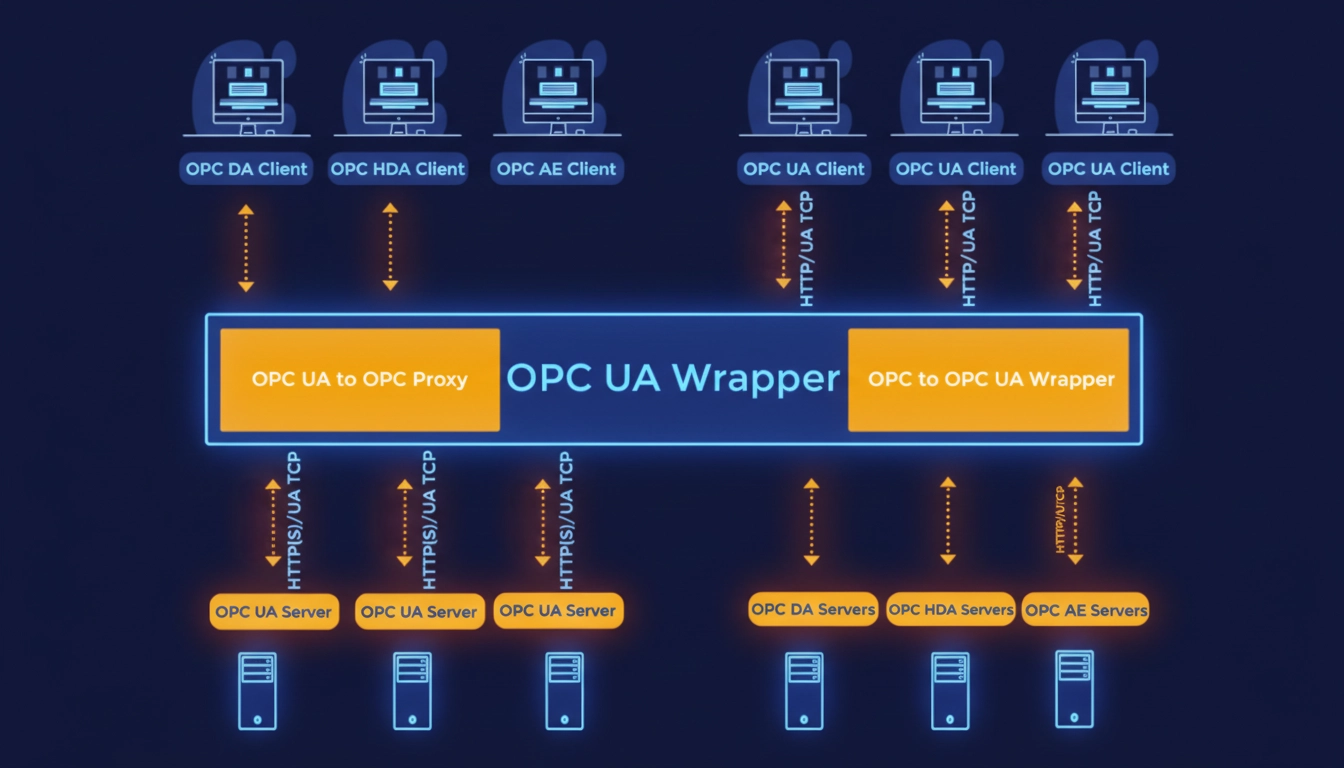
OPC Classic serversOPC UA clients
OPC UA Wrapper
Seamless bridge between OPC Classic servers and OPC UA clients. Migrate without downtime or system replacement.
- Zero downtime migration
- Bidirectional communication
- Auto address mapping


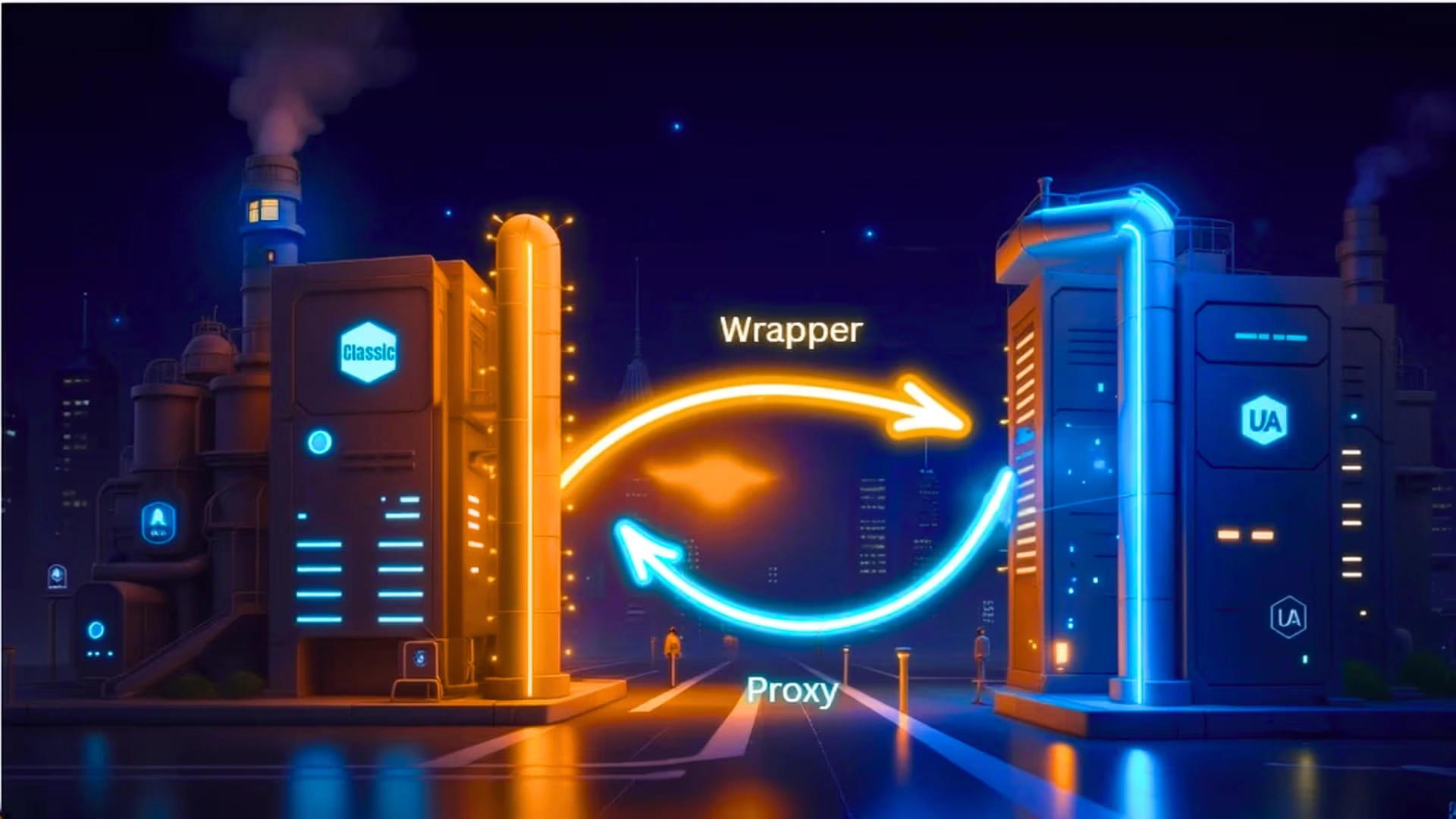
Seamless bridge between OPC Classic servers and OPC UA clients. Migrate without downtime or system replacement.
A high-performance proxy that allows OPC Classic clients to securely connect to OPC UA servers across networks and firewalls.
| Dimension | OPC DA (Classic) | OPC UA (Unified Architecture) |
|---|---|---|
| Underlying architecture | OPC DA (Classic)COM/DCOM | OPC UA (Unified Architecture)Service-oriented, platform-independent |
| Security model | OPC DA (Classic)Windows DCOM permissions, Weak, hard to configure | OPC UA (Unified Architecture)Certificate-based encryption & authentication (built in) |
| Firewall / network friendliness | OPC DA (Classic)Poor, Requires open DCOM port ranges | OPC UA (Unified Architecture)Strong, single configurable port |
| Typical use today | OPC DA (Classic)Legacy installed base across process industries | OPC UA (Unified Architecture)New / greenfield deployments and modernization targets |
| Approach | Downtime | Cost & Effort | Timeline | Infrastructure Reuse |
|---|---|---|---|---|
| Full system replacement | DowntimeHigh: planned outage required | Cost & EffortHigh: new hardware, software, re-engineering | TimelineMonths | Infrastructure ReuseNone. Legacy servers decommissioned |
| Native OPC UA rebuild (app by app) | DowntimeModerate: phased cutovers | Cost & EffortHigh: development + testing per application | TimelineWeeks to months | Infrastructure ReusePartial. Rebuilt incrementally |
| OPC UA Wrapper (tunneling/bridge) | DowntimeNone: runs alongside existing systems | Cost & EffortLow: install and configure, no re-engineering | TimelineSame day, wizard-based setup | Infrastructure ReuseFull. Existing OPC DA/HDA/AE stays in production |
OPC UA Wrapper sits between your OPC Classic servers and your OPC UA clients (or vice versa, via OPC UA Proxy ) as a Windows service.
Deploy OPC UA Wrapper and/or OPC UA Proxy.
Configure your connections: automatic mapping of OPC Classic (DA/HDA/AE) address space to an OPC UA server address space, or vice versa.
Configure certificates, security mode (Sign & Encrypt), and user authentication.
to the wrapper or OPC Classic clients to the Proxy, establish secure communications and read your data. No application changes.
Based on our analysis of 50+ industrial organizations, legacy OPC Classic systems cost 65% more in maintenance, 3x more in security incidents, and 50% slower deployment times. The hidden costs include vendor support fees for obsolete systems, custom integration development costs, security vulnerabilities remediation expenses, and compliance audit preparation time.
Migration timelines vary based on the size and complexity of your OPC infrastructure. However, with OPC UA Wrapper, most organizations complete their migration within the same day thanks to wizard-based installation and seamless integration.
No. With OPC UA Wrapper, you can modernize your communication layer without shutting down existing systems. The wrapper operates alongside your OPC Classic infrastructure, enabling a smooth transition with zero production downtime.
Absolutely. The OPC UA Wrapper is designed to extend the life of your OPC Classic systems by making them accessible to OPC UA clients and vice versa. You can continue using your current servers and applications while gradually adopting OPC UA – no need for a full system replacement.
The wrapper supports data encryption, certificate-based authentication, and multiple security modes and policies, including Sign & Encrypt. It enables secure communication across firewalls and helps you meet modern cybersecurity and compliance standards.
OPC DA relies on Microsoft’s COM/DCOM architecture, is Windows-only, and is difficult to secure over a network. OPC UA is a platform-independent, service-based successor with built-in encryption, authentication, and cross-OS support.
OPC UA Wrapper bridges the two, so DA-based systems can communicate with UA clients without modification.
The fastest path is a converting tool like OPC UA Wrapper, which connects existing OPC DA, HDA, and AE servers to OPC UA clients without replacing hardware or software.
Yes. OPC UA Wrapper is a plug-and-play OPC Classic to OPC UA converter that maps the address space of OPC DA, HDA, and AE servers to an OPC UA server, and includes an OPC UA Proxy for the reverse direction — UA servers to OPC Classic clients
See it in action
Comprehensive technical specifications and features overview
See the OPC product in action with real-world examples
Step-by-step installation and configuration guide
Step-by-step installation and configuration guide