


Why Use OPC AE Client ActiveX for Alarms and Events Applications?
- Powerful suite of ActiveX controls designed for fast and efficient development of OPC Alarms and Events (AE) client applications
- Simplifies the complexities of COM and OPC AE specifications
- Enables rapid integration of real-time alarms and events
- Works within any ActiveX-compatible container or development environment
- Can be used with Microsoft Access, Microsoft Excel, and Visual Basic
- Provides a seamless connection to OPC AE servers
- Allows developers to retrieve and manage alarms and events
- Requires minimal coding effort
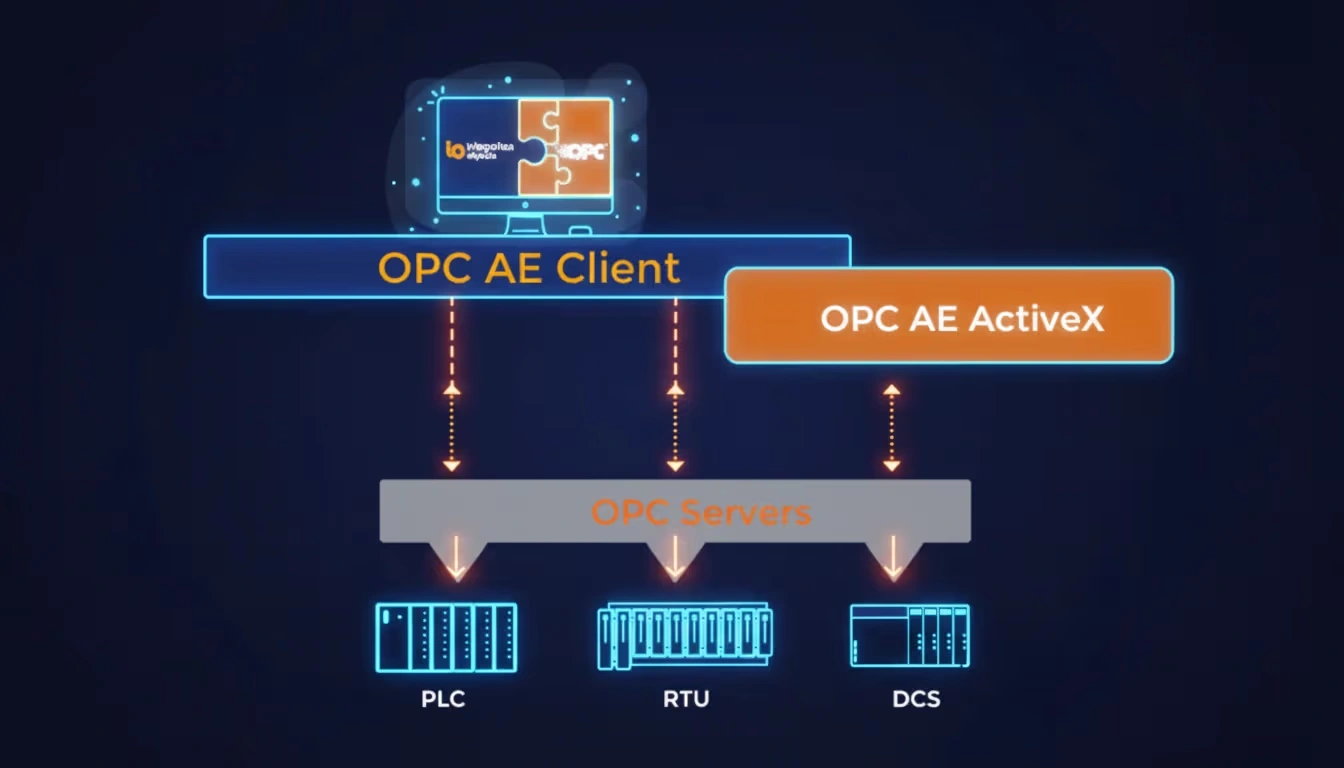
OPC AE Client ActiveX fully complies with the OPC Alarms and Events 1.10 specification. It supports all standard AE features, including condition-based, tracking, and simple event notifications.
Yes. Events can be programmatically logged to any data sink, including databases, text file, or third-party historians.
The control includes built-in connection monitoring and automatic reconnection logic. If a connection to an OPC AE server is lost, it can attempt to re-establish communication based on configurable retry logic. Event subscriptions are re-initialized upon successful reconnection.
The ActiveX control itself is 32-bit, as is typical with COM components. It can run on 64-bit Windows systems using 32-bit containers or applications. For use in a 64-bit .NET application, a separate 32-bit host process or wrapper may be required.
Yes. The component architecture allows simultaneous connections to multiple OPC AE servers, whether local or remote. Each connection is independently managed, with isolated event subscriptions and filters.
OPC AE Client ActiveX Resources
Datasheet
Comprehensive technical specifications and features overview
User Guide
Step-by-step installation and configuration guide