0%
Skip to content
OPC Tunneling

Sharing custody transfer metering data between organizations without connecting their OT networks

How producers, pipeline operators and downstream operators exchange custody transfer metering data DMZ to DMZ with OPCNet Broker® and OPC Data Transfer, without connecting their process control networks.

Products
OPCNet Broker® DA HDA AE, OPC Data Transfer, OPC Buffer
Architecture
DMZ-to-DMZ, three organizations
OT networks connected
None

Overview

Industrial data increasingly has to move between separate organizations: producers, pipeline operators, downstream customers, equipment manufacturers and service providers.

Custody transfer metering is a typical example. Meters and flow computers at custody transfer points measure what changes hands between parties. These measurements are commercially sensitive and subject to legal and regulatory requirements, and every party needs timely, trustworthy access to them to reconcile volumes, nominations and invoices.

This use case shows how OPCNet Broker® DA HDA AE, combined with OPC Data Transfer and data buffering in each DMZ, enables secure OT-to-OT metering data exchange between organizations.

The Challenge

Each party owns its own OT (operational technology) environment, network architecture and security policies, and is responsible for protecting its own systems. Metering systems have traditionally been isolated, and their OPC (Open Platform Communications) interfaces were never designed for external exposure.

Opening those interfaces to partners, or directly connecting two operators' networks, adds cybersecurity risk that most organizations will not accept.

The data therefore had to be shared in a controlled way, where:

  1. Each party sees only the data it is entitled to
  2. The exchange is secure and traceable
  3. Neither side needs inbound access to the other's OT network
  4. Data is buffered during a temporary link outage and delivered when the connection returns.

The Solution

OPC tunneling with OPCNet Broker® is the core building block for secure data transfer between organizations. Combined with a DMZ (demilitarized zone) based architecture, OPC Data Transfer and OPC Buffer, it establishes OPC communication between systems that belong to different organizations without any direct DCOM (Distributed Component Object Model) connectivity between them.

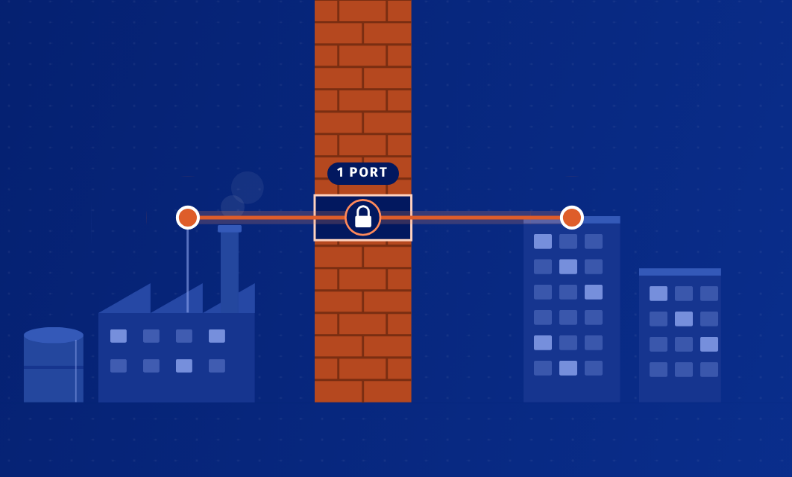
The OPCNet Broker® Client Side and Server Side establish the communication path across the agreed network boundaries, subject to each organization's firewall rules and security policies. Connectivity is restricted to the configured TCP (Transmission Control Protocol) port and approved endpoints, and application whitelisting and tag security limit access to the data points the receiving party is entitled to.

Organizations exchange the agreed industrial data without ever creating a direct network connection between their OT environments.

The architecture

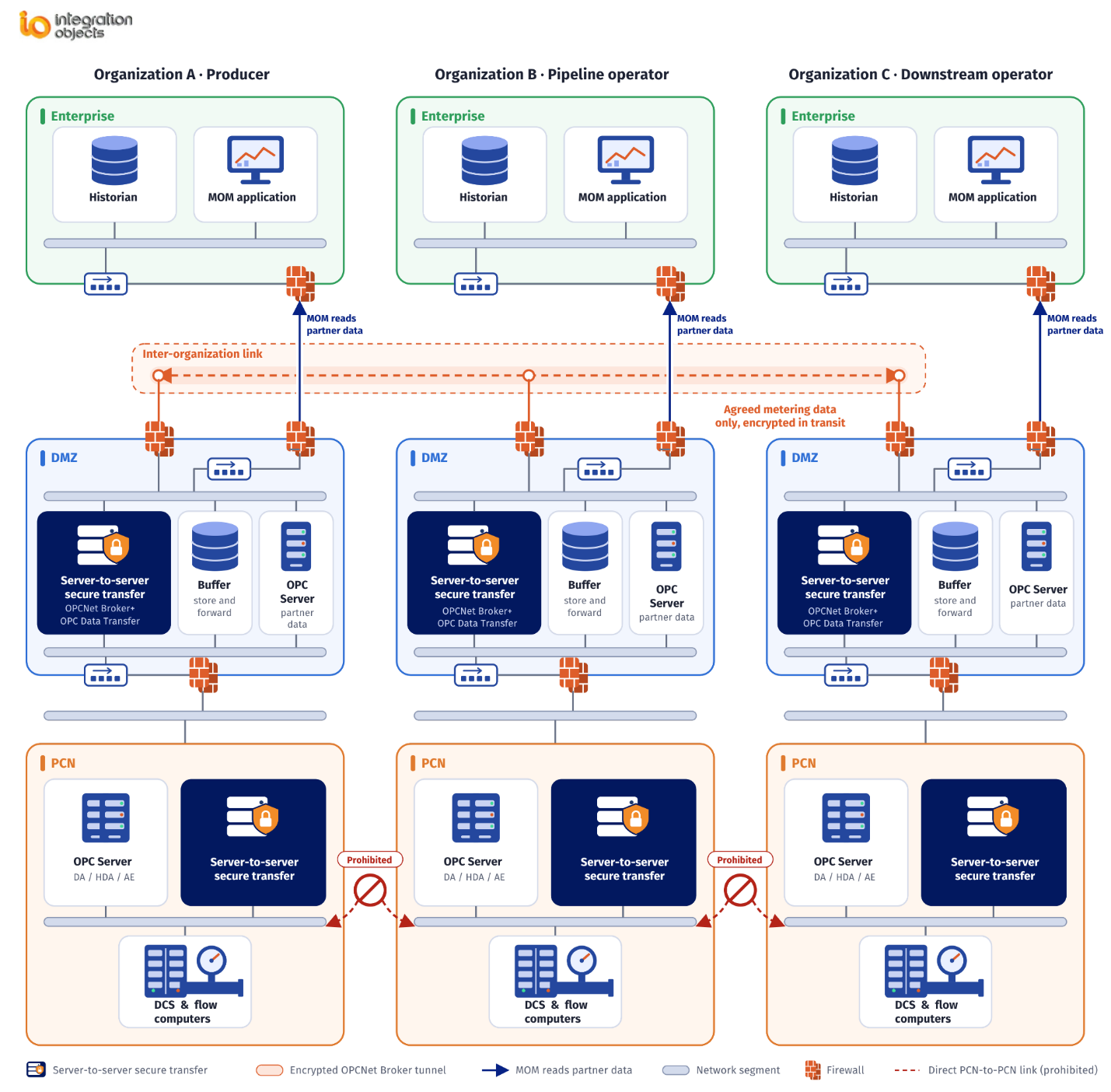
Figure 1: DMZ-to-DMZ metering data exchange between three organizations; direct PCN-to-PCN communication is prohibited

Figure 1: DMZ-to-DMZ metering data exchange between three organizations; direct PCN-to-PCN communication is prohibited

Typical Deployment

Three organizations, for example a producer, a pipeline operator and a downstream operator, each run their own metering and control environment. At each site, an OPC server in the process control network (PCN) collects metering data from the DCS (distributed control system) and flow computers. Each party needs the others' metering data to reconcile volumes and nominations at the custody transfer points.

Direct communication between the process control networks is prohibited. Instead, each site follows the same layered architecture:

  1. The OPC server in the PCN is reachable only from the site's own DMZ, never from another organization. A server-to-server secure transfer moves the agreed data points from the PCN to the site's DMZ.
  2. In the DMZ, a server-to-server secure transfer, built on an OPCNet Broker® tunnel and OPC Data Transfer, sends the agreed metering data over the inter-organization link to the OPC server in each partner's DMZ. Data is buffered during a temporary link outage and delivered when the connection returns.
  3. The enterprise applications at each site, for example the MOM (manufacturing operations management) application used for reconciliation and reporting, read the data from their own DMZ, not from the partners' control networks.

Only the agreed data points leave each site, and each organization keeps full control of its own firewalls and network zones.

To see a similar architecture in production, read the success story Exchanging Control System Data Securely.

See a similar architecture in production

Exchanging Control System Data Securely

Read the success story

Key Benefits

Controlled data exchange

OPC communication between separate industrial environments through dedicated buffer zones or DMZs.

Reduced inter-network exposure

No need to connect the participating OT networks.

Buffered delivery

Metering data is held in the DMZ buffer during a temporary link outage and delivered when the connection returns.

Simplified cross-organizational connectivity

One defined communication path across agreed network boundaries.

Support for industrial collaboration

Data exchange between plant operators, equipment suppliers, system integrators and industrial partners.

Flexible deployment

An architecture that adapts to the security policies of each participating organization.

Security Considerations

OPCNet Broker® simplifies OPC connectivity and reduces dependence on DCOM, but a tunnel alone does not make a deployment secure. For cross-organizational exchanges, the participating parties should agree on the network architecture and permitted data flows before connectivity is established, and should apply the following measures:

Authentication and authorization

Verify connecting endpoints and restrict access to authorized systems with OPCNet Broker® user authentication and application whitelisting.

Encryption

Confirm that encryption is enabled on every OPCNet Broker® tunnel.

Endpoint security

Harden the machines hosting OPCNet Broker® and the associated OPC clients and servers, and keep anti-virus protection up to date.

Firewall policies

Permit only the required communication path and restrict the configured TCP port to approved systems.

Network segmentation

Preserve boundaries between control networks, industrial DMZs, enterprise networks and external organizations.

Monitoring and maintenance

Monitor connection activity, keep relevant logs, apply security updates and review access rules periodically.

Discuss your OPC connectivity architecture

Talk to an Integration Objects expert about your use case, or request a technical assessment of your OPC architecture.

More use cases

All use cases
OPC Tunneling
OPCNet Broker® DA HDA AE

Consolidating OPC data from multiple sites into a central historian

How OPCNet Broker® secures the OPC links between the OPC servers at each plant and a local data collection application, which forwards the data to a central historian or database, with encryption, authentication and tag-level access control.