0%
Skip to content
OPC Tunneling

Connecting OPC clients and servers on the same network without DCOM configuration

How OPCNet Broker replaces DCOM-based OPC Classic connections inside a single plant network with one encrypted tunnel, making OPC links simpler to deploy, secure and troubleshoot.

Overview

OPC (Open Platform Communications) Classic remains the backbone of data exchange in many plants, linking PLCs (programmable logic controllers), SCADA (supervisory control and data acquisition) systems, DCS (distributed control system) platforms, historians and plant applications. OPC Classic relies on Microsoft DCOM (Distributed Component Object Model) whenever the OPC client and the OPC server run on different machines.

This use case shows how OPCNet Broker® DA HDA AE removes the need to configure DCOM between machines, even when both systems sit on the same network.

The Challenge

Even inside a single plant network, a remote OPC Classic connection requires DCOM permissions, authentication settings, firewall rules and Windows security policies to be configured and kept aligned on both machines.

These settings are time-consuming to get right, hard to troubleshoot when a connection fails, and easily broken by operating system updates or security hardening. Every DCOM opening is also a potential attack surface that must be managed and reviewed over the life of the system.

The plant needed an approach that would:

  1. Remove the need to configure DCOM between the OPC client and OPC server machines
  2. Reduce the security exposure associated with DCOM
  3. Make OPC connections faster to deploy and easier to troubleshoot
  4. Keep administration simple over the life of the system

The Solution

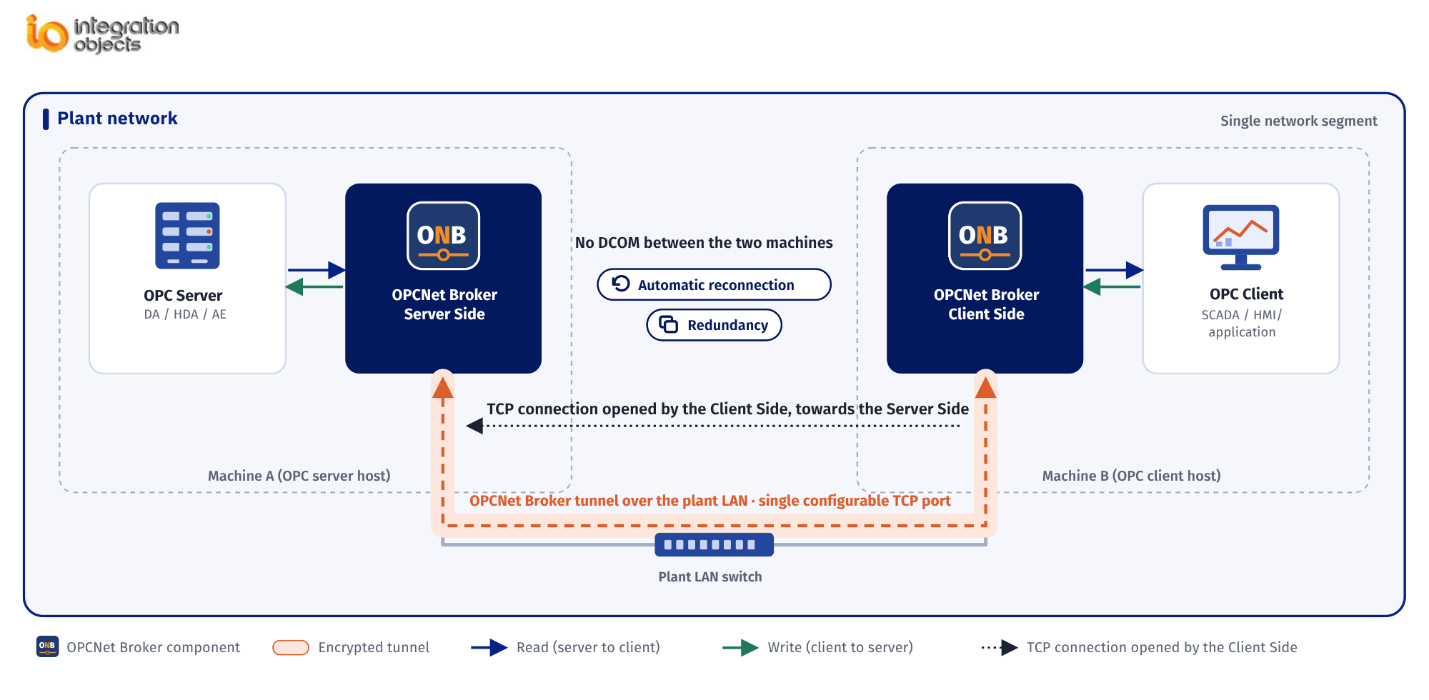
OPCNet Broker® establishes a tunnel between the OPCNet Broker Client Side, installed on the OPC client machine, and the OPCNet Broker Server Side, installed on the OPC server machine.

The OPC client connects locally to the OPCNet Broker Client Side as if it were the OPC server. OPC calls are carried through the encrypted tunnel over a single configurable TCP (Transmission Control Protocol) port, and the OPCNet Broker Server Side passes them locally to the target OPC DA (Data Access), HDA (Historical Data Access) or AE (Alarms and Events) server.

Both machines stay on the same network, but no DCOM communication is required between them.

The architecture

Figure 1: OPCNet Broker tunnel between an OPC client and an OPC server on the same plant network

Figure 1: OPCNet Broker tunnel between an OPC client and an OPC server on the same plant network

Typical Deployment

A SCADA application needs to read real-time data from an OPC DA server running on another machine in the same plant network.

Instead of configuring DCOM on both machines, the engineering team installs the OPCNet Broker Client Side on the SCADA machine and the OPCNet Broker Server Side on the OPC server machine. The SCADA client then browses and reads the OPC server through the tunnel, with no change to the SCADA application or the OPC server.

The result is a simpler OPC communication architecture that no longer depends on DCOM between machines.

Key Benefits

Simplified deployment

No DCOM configuration for the OPC communication path.

Reduced DCOM exposure

Remove the DCOM openings and associated security settings between machines.

Easier troubleshooting

One dedicated communication channel over a single TCP port between the two sides.

Improved maintainability

Simpler administration of OPC connections, unaffected by DCOM changes from Windows updates or hardening.

Security Considerations

A tunnel alone does not make an OPC deployment secure. In production, enable encryption and user authentication on the OPCNet Broker® tunnel, restrict the configured TCP port to approved hosts, use application whitelisting, and harden the machines hosting OPCNet Broker® and the OPC applications. The full checklist is available in the use case "Sharing Custody Transfer Metering Data Between Organizations Without Connecting Their OT Networks".

Discuss your OPC connectivity architecture

Talk to an Integration Objects expert about your use case, or request a technical assessment of your OPC architecture.

More use cases

All use cases
OPC Tunneling
OPCNet Broker® DA HDA AE

Consolidating OPC data from multiple sites into a central historian

How OPCNet Broker® secures the OPC links between the OPC servers at each plant and a local data collection application, which forwards the data to a central historian or database, with encryption, authentication and tag-level access control.