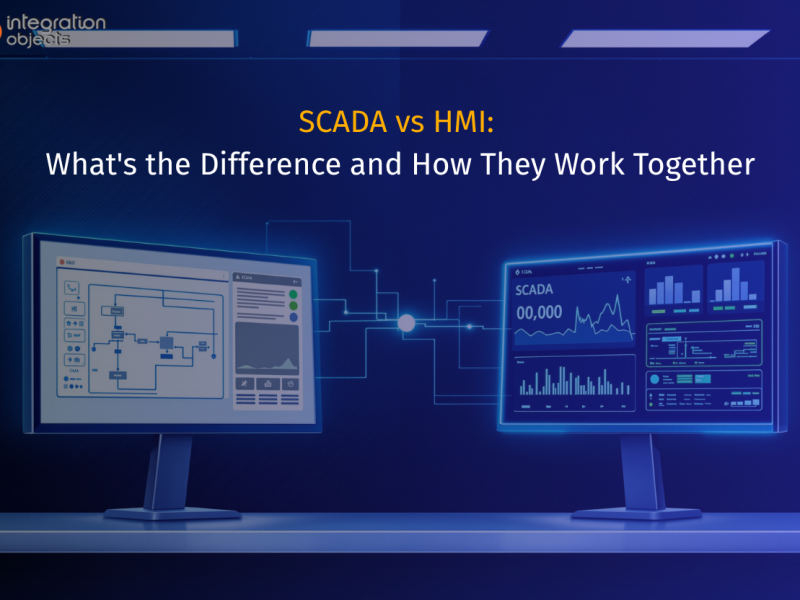
SCADA (Supervisory Control and Data Acquisition) is a category of industrial control system software and hardware that lets operators monitor and control equipment and processes – locally or across distributed sites – from a centralized interface. A SCADA system collects real-time data from field devices such as sensors, PLCs, and RTUs, displays it through a human-machine interface (HMI), and lets operators issue commands, log historical data, generate and respond to alarms. SCADA is the supervisory layer that sits between plant-floor control and the rest of the enterprise.
This guide covers how SCADA works, how it differs from PLCs, DCS, and HMI, how it evolved from mainframe computers to web-based platforms, and where SCADA fits in the broader IT/OT connectivity picture, including its relationship to OPC UA and MQTT.
How Does a SCADA System Work? (Core Components)
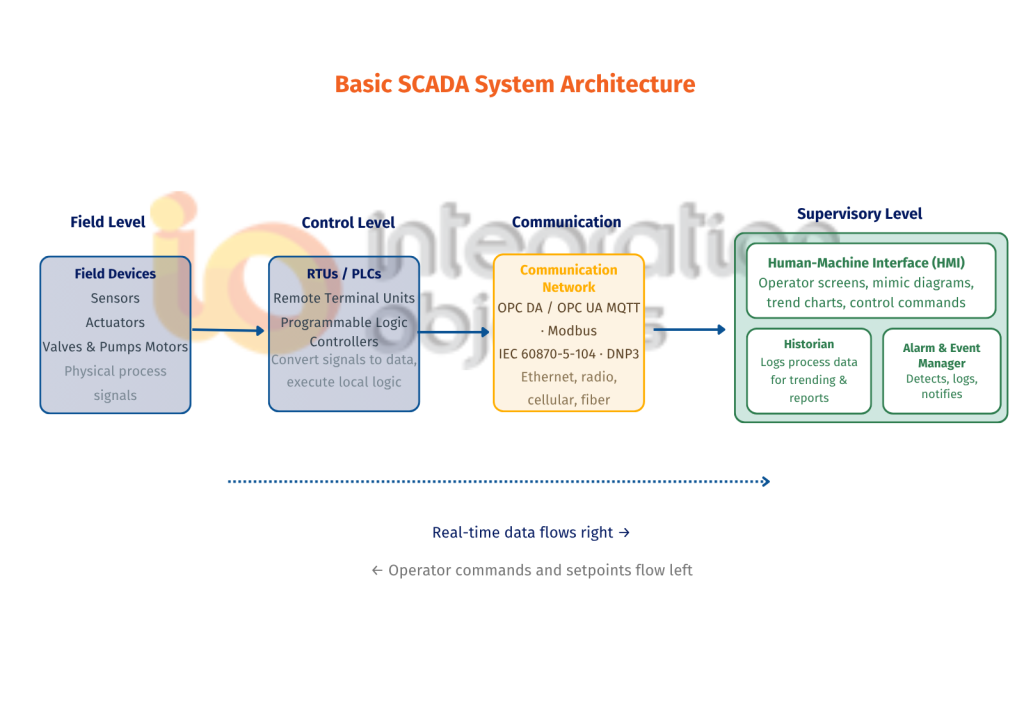
Every SCADA system, regardless of vendor or industry, is built from the same functional building blocks:
- Field devices: sensors, actuators, valves, pumps, and motors that generate or act on physical process signals.
- RTUs and PLCs: Remote Terminal Units and Programmable Logic Controllers that convert field signals into data and execute local control logic close to the equipment.
- Communication network: the wired or wireless layer that carries data between field devices and the SCADA server, using protocols such as OPC DA, OPC UA, MQTT, Modbus, DNP3, or IEC 60870-5-104.
- SCADA server: the central system that aggregates data, runs supervisory logic, and coordinates the historian and alarm manager.
- Historian: logs process data over time for trending, compliance reporting, and analysis.
- Human-Machine Interface (HMI): the operator-facing screens: mimic diagrams, trend charts, and controls for issuing commands.
Data flows from the field upward through this chain in real time; operator commands and setpoints flow back down the same path. The diagram below shows this end-to-end architecture.
SCADA vs. PLC vs. DCS vs. HMI: Clearing Up the Confusion
These four terms get used interchangeably, but they describe different layers of an industrial control system:
| Term | What It Is |
Typical Scope |
| SCADA | Software + hardware system for supervisory monitoring and control | Site-wide or multi-site; supervises many PLCs/RTUs |
| PLC | Hardware controller running real-time logic | A single machine or process cell |
| DCS (Distributed Control System) | A control architecture where control logic is distributed across many controllers, typically for continuous processes | Plant-wide continuous process control (refineries, chemical plants) |
| HMI | The visualization/operator-interaction layer | A component within SCADA (or standalone on a single machine) |
In short: a PLC executes control at the machine level, SCADA supervises many PLCs across a wider area, DCS is a distributed-control architecture more common in continuous-process industries, and the HMI is the screen operators actually look at – which can exist inside a SCADA system or on its own.
Where SCADA Fits: The Purdue Model and OPC Connectivity
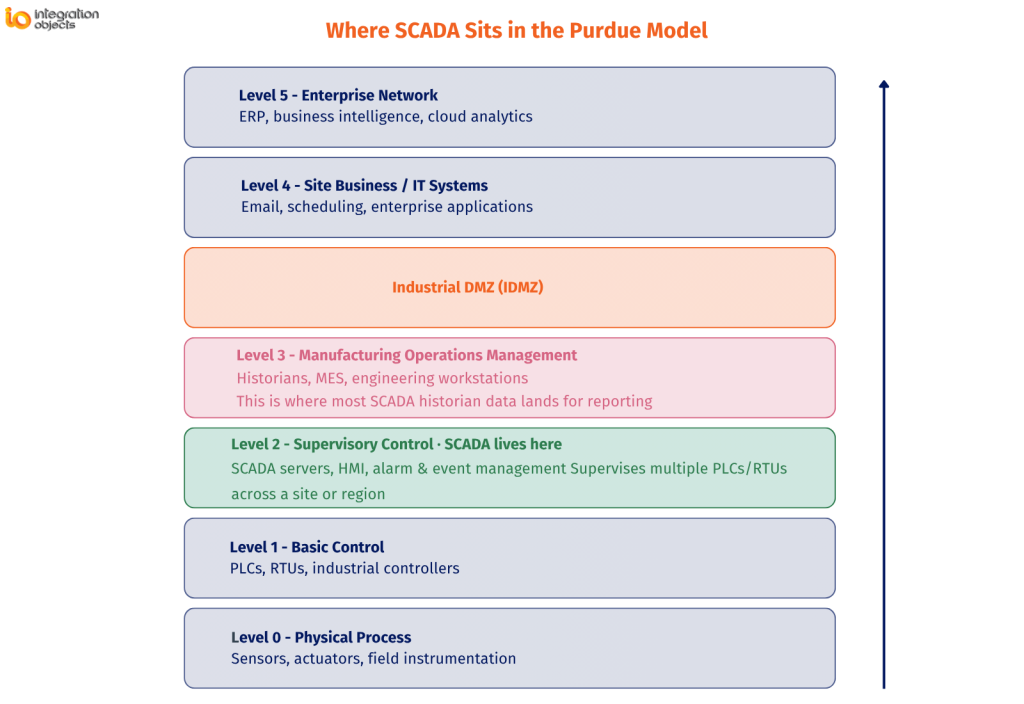
Most “What is SCADA” guides stop at the definition. But understanding SCADA’s real value means understanding where it sits relative to the rest of the industrial and enterprise stack, commonly mapped using the ISA-95 / Purdue Enterprise Reference Architecture:
- Level 0-1: Physical process, sensors, PLCs, and RTUs.
- Level 2: Supervisory control. This is where SCADA and HMI live.
- Level 3: Manufacturing Operations Management: historians, Manufacturing Execution Systems (MES), engineering workstations.
- Industrial DMZ (IDMZ): the secure buffer zone where OPC UA and MQTT gateways safely carry data between OT and IT without exposing the plant floor.
- Level 4-5: Site business systems and enterprise IT (ERP, cloud analytics).
SCADA was never designed to talk directly to enterprise IT systems. That’s the job of the connectivity layer sitting in and around the IDMZ, including integration platforms, OPC UA servers, MQTT brokers, and protocol gateways, which allows SCADA data to reach historians, MES, and cloud analytics securely. This is the layer where OPC connectivity and IT/OT integration tools operate.
The Evolution of SCADA: From Monolithic to Web-Based Systems
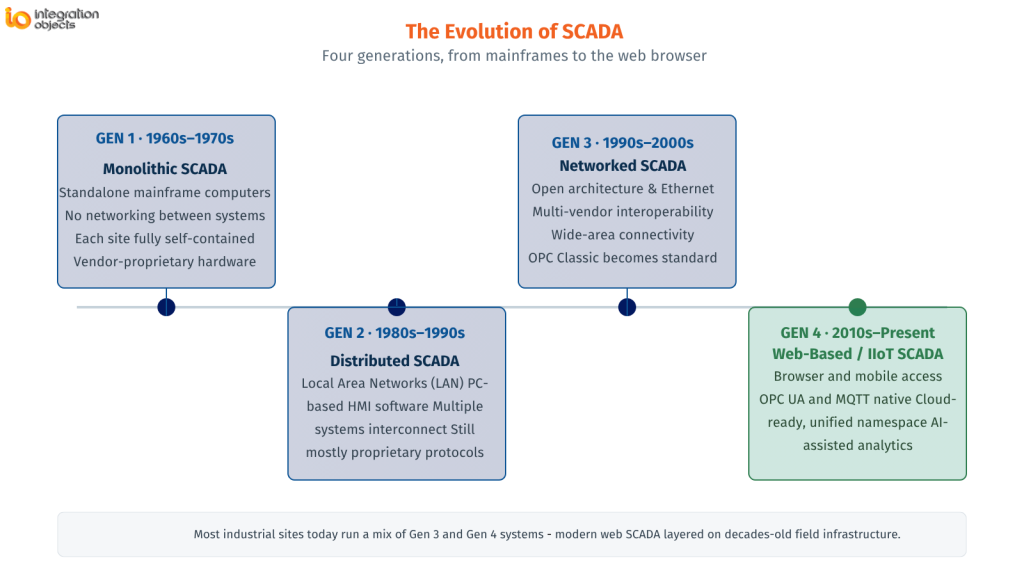
SCADA has gone through 4 broad generations since the concept emerged in the early 1970s:
· Generation 1: Monolithic SCADA (1960s-1970s)
Standalone mainframe computers with no networking between systems. Each site was fully self-contained, running on vendor-proprietary hardware.
· Generation 2: Distributed SCADA (1980s-1990s)
Local Area Networks (LAN) and PC-based HMI software allowed multiple systems to interconnect, though protocols were still mostly proprietary, limiting cross-vendor communication.
· Generation 3: Networked SCADA (1990s-2000s)
SCADA adopted open architectures and Ethernet, enabling multi-vendor interoperability and wide-area connectivity. OPC Classic became a de facto standard for exchanging data between systems from different vendors.
· Generation 4: Web-Based / IIoT SCADA (2010s-present)
Modern SCADA is web browser- and mobile-accessible, built around OPC UA and MQTT, cloud-ready, and increasingly organized around a unified namespace with AI-assisted analytics layered on top.
Most industrial sites today run a mix of Generation 3 and Generation 4 systems – modern, web-based SCADA layered on top of decades-old field infrastructure.
Legacy vs. Modern SCADA Systems
| Legacy SCADA | Modern SCADA |
| Hardware-centric, client-installed software | Software-defined, web browser and mobile access |
| Proprietary protocols, limited interoperability | Open standards such as OPC UA and MQTT |
| Difficult and costly to scale across sites | Scalable, cloud-ready architecture |
| Heavy reliance on manual monitoring | Advanced analytics and AI-assisted decision support |
| Vulnerable to cyber threats (outdated protocols, DCOM dependency) | Built-in cybersecurity, reduced attack surface |
Industries That Rely on SCADA
SCADA systems run behind the scenes across nearly every industrial sector, including:
- Oil & gas (upstream, midstream, downstream)
- Water and wastewater treatment
- Energy and power generation/distribution
- Manufacturing and discrete production
- Food and beverage
- Pharmaceuticals and life sciences
- Transportation and logistics
Common SCADA Challenges Today
Even well-run SCADA deployments run into recurring friction points as operations scale and modernize:
- Legacy protocol lock-in: older SCADA systems depend on DCOM for communications with OPC Classic servers but also for communications between components within the SCADA vendor’s own architecture, which is fragile across networks and difficult to secure.
- IT/OT data silos: SCADA data often stays trapped at Level 2-3, never reaching the systems that could act on it.
- Cybersecurity exposure: aging SCADA components were not designed for today’s threat landscape.
- Scaling across multi-site operations: many legacy SCADA architectures were built for a single site, not a distributed enterprise.
What Comes Next: Modern, Web-Based SCADA
The industry’s answer to these challenges is web-native SCADA built on open standards from the ground up:
- OPC UA for plant-floor interoperability,
- MQTT/Sparkplug B for edge-to-cloud connectivity,
- and web browser-based access instead of installed clients.
SIOTH® SCADA is built on exactly this model: OPC UA-native, supporting OPC DA, Modbus, MQTT, Sparkplug B, IEC 60870-5-104, DNP3, Allen-Bradley, and Profinet, with a free Community Edition entry point for teams evaluating a modern SCADA platform.
Frequently Asked Questions
What is the difference between SCADA and a PLC?
A PLC is a hardware controller that executes real-time logic for a single machine or process. SCADA is the supervisory software and hardware layer that monitors and coordinates many PLCs across a site or region.
What is the difference between SCADA and DCS?
SCADA and DCS are both used to monitor and control industrial processes, but they traditionally differ in their primary scope and architecture. SCADA systems are typically designed for supervisory monitoring and control across geographically distributed assets or multiple sites, while a DCS (Distributed Control System) is designed to provide integrated, continuous control across a plant, with control functions distributed among multiple controllers.
SCADA is commonly used in applications such as water and wastewater, oil and gas pipelines, electrical distribution, and other geographically distributed infrastructure. DCS platforms are more commonly associated with continuous-process industries such as oil refining, chemicals, and power generation.
Is SCADA the same as HMI?
No. The HMI is the visual, operator-facing component: screens, dashboards, and controls. It's typically one part of a larger SCADA system, though simple HMIs can also run standalone on individual machines.
What is a SCADA historian?
A SCADA historian is the component that logs time-stamped process data for trending, compliance reporting, and analysis and is usually backed by a SQL or time-series database.
Is SCADA still used today, or is it outdated?
SCADA is still the standard supervisory layer across most industrial sectors. What has changed is the technology underneath it. Modern SCADA is web-based, built around open standards such as OPC UA and MQTT, and cloud-ready, replacing the proprietary, hardware-centric systems of earlier generations.
Can SCADA run in the cloud?
Modern SCADA platforms increasingly support cloud deployment and web browser-based access, though most industrial sites still keep supervisory control on-premises or at the edge for latency and reliability reasons, while sending historized data to the cloud for analytics.