Modern industrial plants generate massive volumes of operational data every second from sensors, PLCs, SCADA systems, alarms, and other control equipment. Plant data centralization plays a critical role in turning this information into actionable insights that improve operational efficiency, reliability, and decision-making.
However, many industrial organizations face two major challenges. First, plant data often remains scattered across multiple systems, creating information silos that make it difficult to gain a unified view of operations. Second, traditional historians frequently rely on tag-based licensing models, which can significantly increase costs as the number of monitored signals grows.
As a result, companies need a cost-effective approach to centralizing plant data while maintaining reliability and scalability.
Why Plant Data Centralization Matters
Centralizing industrial data is no longer optional for modern manufacturing environments. When organizations collect and store plant data in a centralized repository, they gain a consistent and accessible source of operational information.
This approach enables companies to:
-
Improve operational visibility across the entire plant
-
Accelerate data-driven decision making
-
Simplify reporting and compliance requirements
-
Enable advanced analytics and predictive maintenance
-
Support digital transformation initiatives
Without centralized access to plant data, engineers and operators often waste valuable time navigating multiple systems just to retrieve basic information.
The Industrial Data Challenge in Modern Plants
Most industrial facilities rely on a complex ecosystem of technologies, including:
-
PLCs
-
SCADA systems
-
DCS platforms
-
HMIs
-
historians
-
intelligent field devices
Each system generates valuable operational data. However, these systems frequently store information in different protocols, databases, or proprietary formats.
Consequently, organizations encounter several common challenges.
-
Disparate Data Sources
Operators often need to access multiple systems to retrieve simple process data. This fragmentation slows down troubleshooting and operational analysis.
-
Limited Historical Visibility
Without a centralized storage strategy, retrieving historical process values or alarm sequences becomes difficult and time-consuming.
-
Slower Decision-Making
When data remains fragmented, teams struggle to quickly detect process deviations, equipment failures, or inefficiencies.
-
Integration Complexity
Connecting plant data to analytics platforms, cloud systems, or enterprise applications becomes much harder when data lacks a standardized and centralized architecture.
These limitations can slow operational improvements and hinder initiatives such as predictive maintenance, root cause analysis, and advanced analytics.
Centralizing Plant Data with OPC Easy Archiver
To address these challenges, organizations need a reliable way to collect and store industrial data from multiple sources.
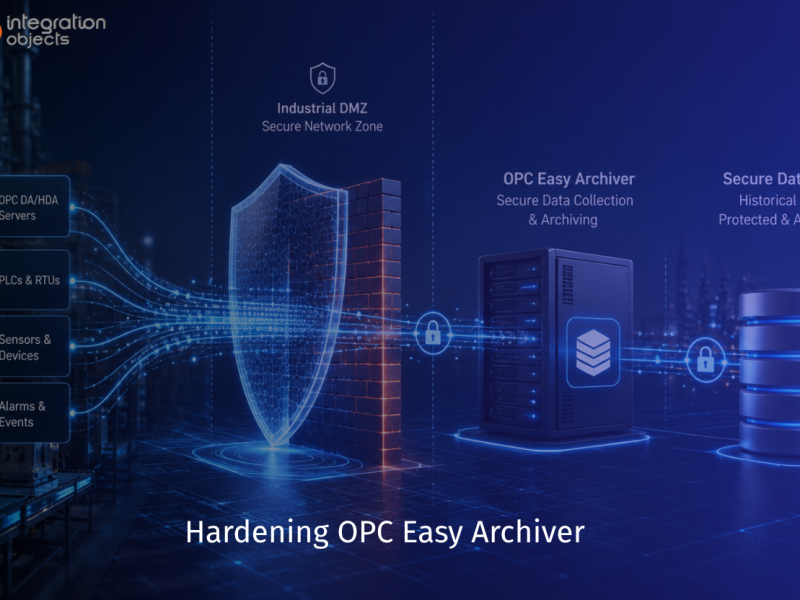
OPC Easy Archiver provides a centralized data logging solution that collects real-time values, historical trends, and alarms from multiple OPC servers. The system then stores this information in widely used databases or flat files, creating a reliable data foundation for reporting and analytics.
The archiver supports several OPC standards, including:
-
OPC DA for real-time process data
-
OPC HDA for historical process data
-
OPC AE for alarms and events
Once collected, the system can store the data in databases such as:
-
Microsoft SQL Server
-
Azure SQL
-
Oracle
-
MySQL
-
PostgreSQL
-
Microsoft Access
Alternatively, organizations can export data into CSV files for easy portability.
This flexible architecture allows companies to integrate plant data with existing analytics platforms, dashboards, or enterprise systems.
Archiver is a robust OPC client application designed to reliably collect and historize industrial data from OPC DA, HDA, and AE servers. Whether data is coming from local or remote sources, the archiver captures real-time values, historical process trends, and critical alarms or events, and stores them securely in widely used databases such as Microsoft SQL Server, Azure SQL, Oracle, MySQL, PostgreSQL, Microsoft Access, or in flat files like CSV.
Key Capabilities for Reliable Data Centralization
Centralizing and managing your plant data isn’t just about moving data into one place, it’s about doing it reliably and efficiently OPC Easy Archiver delivers on all fronts. Here is how:
- Multi-Protocol Support (DA, HDA, AE)
OPC Easy Archiver is designed for broad compatibility with OPC standards, making it ideal for mixed environments with legacy and modern equipment. It supports:
- OPC DA (Data Access) for real-time process values.
- OPC HDA (Historical Data Access) for collecting historical trends
- OPC AE (Alarms & Events) to capture critical alerts and status changes
This multi-protocol supports ensures that no valuable data is left behind, regardless of its source.
- Flexible Data Destinations:
One of OPC Easy Archiver’s biggest strengths is its wide range of storage targets, allowing you to archive data in the format and location that best fits your IT infrastructure:
- Relational databases like MS SQL Server, Oracle, MySQL, PostgreSQL, Azure SQL
- Microsoft Access for smaller-scale or local storage
- CSV files for portability and simplicity
Using standard ODBC/OLEDB connections, the system integrates seamlessly into existing enterprise data flows, making it easy to connect archived plant data with reporting, analytics, or visualization tools – key components of any industrial data management strategy.
- Store-and-Forward Reliability
Unreliable network connections or temporary server failures shouldn’t mean lost data. OPC Easy Archiver features store-and-forward mechanisms, ensuring that:
- Data is locally buffered during connection issues
- It is automatically forwarded to your database server once connectivity is restored
- Your records remain complete and continuous, even across outages.
- Automated Rules and Triggers
With OPC Easy Archiver, you can configure rules-based automation to react to specific data conditions or events.
Examples include:
- Sending email alerts when thresholds are exceeded
- Automatically starting/stopping the archiving process
- Logging events or taking action based on alarm conditions.
This intelligent automation reduces the need for manual oversight and enables proactive maintenance and operations.
- Cost optimization
The OPC Easy Archiver is cost effective solution for OPC data logging as its license does not depend on the number of connected servers or the number of tags. With the OPC Easy Archiver, you can:
- Connect to multiple OPC servers simultaneously, local or remote
- Centralize data from distributed control systems (DCS), PLC networks, or edge devices
- Store everything in one central database, or keep site-level separation as needed.
This flexibility makes it suitable for enterprises aiming to implement a cohesive industrial data management strategy across global operations.
Download User Guide
Use Case Example: Monitoring Compressor Performance
Imagine a manufacturing plant monitoring multiple compressors across different lines. Each compressor exposes real-time and historical data via OPC DA and HDA servers. With OPC Easy Archiver:
- Data is collected continuously (temperatures, pressures, run hours)
- Alarms (e.g., high vibration) are logged using OPC AE
- Data is archived to a central SQL database
- A power BI dashboard visualizes compressor performance trends and alerts maintenance teams when thresholds are breached.
The result? Centralized visibility, predictive maintenance, and less unplanned downtime
Benefits of Plant Data Centralization with OPC Easy Archiver
When you centralize plant data using OPC Easy Archiver, the benefits go beyond convenience:
- Improved Visibility and Decision-Making:
Operators, engineers, and analysts gain access to clean, consistent data across all systems enabling better analysis, root cause investigation, and optimization.
- Easier Regulatory Compliance:
Traceability is critical in regulated industries. OPC Easy Archiver helps you maintain audit-ready data records, including alarms, process values, and historical logs automatically.
- Analytics Integration
Archived data is stored in standard databases making it simple to plug into:
– Predictive analytics models
– Cloud platforms for data warehousing
- Reduced Downtime and Better Reliability
With its auto-reconnect features, OPC Easy Archiver ensures you don’t lose data when connections drop providing a more reliable data backbone for your plant and improving overall industrial data management efficiency.
Start Building a Unified Data Backbone
As industrial plants embrace digital transformation, centralized data is the foundation for smarter decisions, reduced downtime, and competitive advantage. OPC Easy Archive provides the tools to capture and centralize your plant’s most valuable asset – its data – in a way that is cost effective, reliable, and easy to implement.
OPC Easy Archiver empowers you to:
- Unify disparate data streams
- Enable real-time and historical analysis
- Support modern analytics and compliance needs
Start centralizing your plant data today and unlock the full value of your industrial operations.
Conclusion
Plant data centralization provides the foundation for modern industrial analytics, operational visibility, and digital transformation. By consolidating data from multiple systems into a unified repository, organizations can improve decision-making, increase reliability, and unlock new insights from their operations.
Products such as OPC Easy Archiver simplify this process by collecting industrial data from multiple OPC sources and storing it in standard databases, making plant information accessible for reporting, analytics, and optimization.
As industrial companies continue to adopt data-driven strategies, centralized data management will remain a key enabler of smarter and more efficient operations.
FAQ on Plant Data Centralization
How can I collect and store OPC data in a database?
OPC Easy Archiver extracts data from OPC servers and stores it in databases such as SQL Server, MySQL, or PostgreSQL, making the information accessible for reporting, dashboards, and analysis.
How can I scale industrial data collection efficiently?
OPC Easy Archiver can handle growing data volumes without adding complexity. It allows you to connect to multiple sources and expand your data collection strategy with ease, while also helping manage costs by avoiding tag-based or connection-based licensing models.
How does OPC Easy Archiver unify industrial system data?
OPC Easy Archiver brings together data from PLCs, SCADA, DCS, and HMIs into a single view, making it easier to monitor operations and feed analytics platforms, dashboards, or enterprise applications.
How can I store industrial data for reporting and predictive maintenance?
Industrial data should be stored in structured databases or accessible formats like CSV to support analysis and long-term tracking. OPC Easy Archiver archives data in common databases, making it easier to use in dashboards, reporting tools, and predictive maintenance models.