Understanding MQTT is essential for anyone working with connected devices – whether you’re building IoT products or evaluating how industrial systems communicate. It’s the messaging protocol behind much of today’s real-time data exchange, from smart home devices to large-scale industrial automation.
MQTT (Message Queuing Telemetry Transport) is a lightweight messaging protocol built for environments with limited bandwidth, processing power, or battery life. Using a publish-subscribe model, MQTT lets devices exchange data without maintaining constant connections, making it well suited to everything from small sensors to complex industrial systems.
MQTT was originally developed in the late 1990s to monitor oil pipelines over satellite networks, designed from the start to handle unreliable connections and low bandwidth. Its simplicity led to broad adoption, and in 2013 it became an OASIS standard. MQTT 5.0, released in 2019, added features to meet the growing demands of modern IoT deployments.
Today, MQTT powers reliable, scalable communication across everything from tiny edge sensors to complex industrial machinery, enabling real-time data collection, remote monitoring, and automated control.
MQTT Architecture: Publishers, Subscribers, Topics, and QoS
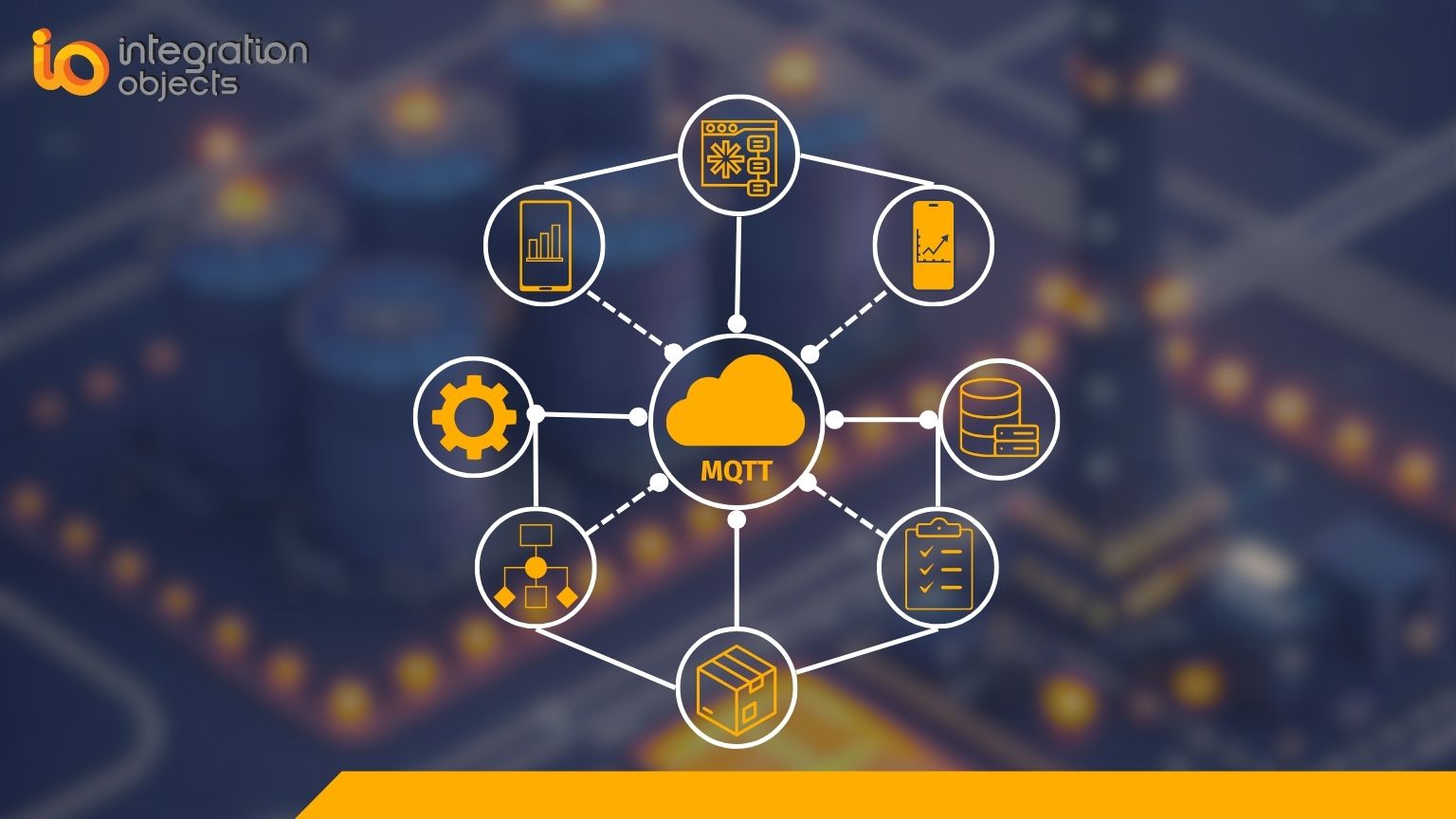
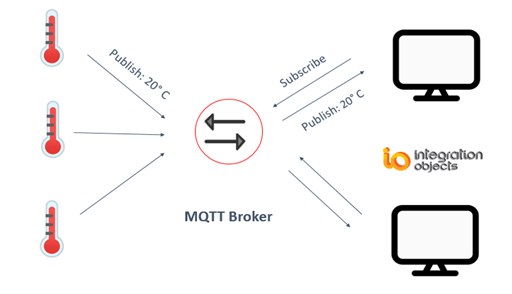
At its core, MQTT relies on a publish-subscribe model coordinated by a central broker.
Publisher-Subscriber Model
- Publishers send messages to specific topics – think of these as labeled channels.
- Subscribers listen to the topics they’re interested in and receive messages published there.
Broker
The broker acts as the middleman, routing messages from publishers to the right subscribers. It’s what gives MQTT its reliability and scalability, removing the need for devices to connect to each other directly.
Topics
Topics organize messages hierarchically, using forward slashes (e.g., home/kitchen/temperature). MQTT supports wildcards for flexible subscriptions:
- Single-level wildcard (+): Matches one topic level (e.g., home/+/temperature).
- Multi-level wildcard (#): Matches any number of levels (e.g., home/#).
Quality of Service (QoS)
MQTT offers three delivery levels:
- QoS 0 (At Most Once): Best effort, no delivery guarantee; suitable when occasional message loss is acceptable.
- QoS 1 (At Least Once): Ensures delivery but may cause duplicates.
- QoS 2 (Exactly Once): Guarantees each message arrives once without duplicates, ideal for critical applications.
Lightweight and Efficient
MQTT is designed for resource-limited devices:
- Minimal protocol overhead (only 2-byte fixed header).
- Low power consumption thanks to minimized data exchange and intermittent connections.
- Efficient bandwidth use, supporting many clients with minimal network load.
Benefits and Limitations of MQTT
- Benefits
- Low Bandwidth Usage: MQTT’s lightweight design minimizes data transmission, making it ideal for networks with limited capacity or high latency, such as cellular or satellite connections.
- Minimal Battery Drain: By reducing data exchange and allowing intermittent connections, MQTT helps conserve battery life, perfect for sensors and wearables that need long operation times.
- Scalability and Flexibility: Its publish-subscribe model allows devices to be added or removed without disrupting the network. The flexible topic structure supports a wide range of applications, from simple data gathering to complex automation.
- Limitations:
- Not Suitable for Large Payloads: MQTT handles small messages efficiently but isn’t designed for transmitting large files or datasets. Protocols like HTTP or FTP are better for those cases.
- No Built-In Security: MQTT lacks native encryption or security features. To protect data, you must add layers like TLS/SSL encryption, which can increase complexity and resource use.
MQTT in an Industrial Setting
MQTT has become a cornerstone of Industrial IoT (IIoT) thanks to its efficiency, reliability, and scalability. It excels in real-time data acquisition, monitoring, and control, even in challenging environments like manufacturing plants, oil fields, and remote utilities where connectivity can be intermittent and bandwidth limited.
Industrial Use Cases for MQTT:
- Predictive Maintenance: By continuously monitoring sensors for vibration, temperature, and other indicators, MQTT helps predict equipment failures before they happen, minimizing costly downtime.
- Real-Time Monitoring and Control: Operators receive up-to-date data on production speed, temperature, or pressure and can remotely adjust settings to optimize operations and ensure safety.
- Energy Management: MQTT enables smart energy systems to track consumption across devices with frequent, low-overhead updates, helping identify inefficiencies and reduce costs.
- Supply Chain Automation: By bridging legacy systems and modern IoT, MQTT facilitates real-time communication needed to manage inventories, coordinate logistics, and track shipments effectively.
Introducing MQTT Universal Broker
While MQTT provides a solid foundation for industrial communication, scaling and integrating diverse systems in complex operations requires advanced solutions. The MQTT Universal Broker plays a crucial role by offering enhanced scalability, flexibility, and seamless IT-OT integration, bridging operational systems with the cloud.
Capable of handling millions of messages per second, the broker connects operational technology (OT) protocols with cloud platforms, supporting real-time, bidirectional communication between Ilot devices and automation systems.
Part of the platform, it ensures smooth data exchange, transformation, and secure end-to-end integration for critical industrial operations. Its scalable design supports multiple protocols simultaneously, making it ideal for environments ranging from a handful of sensors to millions of IoT data sources.
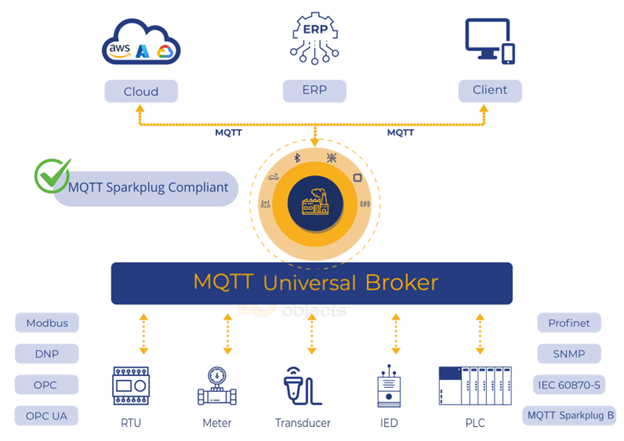
Key Features and Benefits of the MQTT Universal Broker:
- High Scalability: Supports millions of simultaneous connections across multiple protocols, effortlessly handling growing volumes of IIoT data and automation systems.
- Robust Performance: Engineered for demanding environments, it processes millions of messages per second, ensuring real-time communication without bottlenecks.
- Cloud-Innate: Supports reliable and secure data flows between edge devices, cloud platforms, and on-premises systems
- Seamless SIOTH® Integration: Fully integrated with the SIOTH® platform, supporting industrial protocols such as OPC UA, Modbus, DNP3, SNMP, and Profinet, with a reliable and secure publish/subscribe architecture.
- Advanced Data Processing: Equipped with a powerful rule engine to transform raw IoT data into actionable insights, aggregates, alerts, notifications, and performance metrics for real-time operational response.
- Unified Data Model: Uses SIOTH®’s flexible hierarchical data modeling for comprehensive, unified views across complex industrial assets.
- MQTT Compatibility: Supports both MQTT Standard and MQTT Sparkplug B, ensuring broad industrial device compatibility.
- Flexible Communication Protocols:
- MQTT: Ideal for unreliable networks and resource-limited devices.
- MQTT over WebSockets: Extends support to web applications and less constrained devices.
- Robust Security: Includes basic authentication and TLS/SSL encryption to protect data and industrial assets from unauthorized access.
- Data Visualization: Offers a web-based environment for building dashboards and SCADA displays, providing intuitive, real-time system monitoring.
- Universal Connectivity: Converts multiple industrial protocols into a single MQTT stream, enabling secure communication with cloud providers. Supported protocols include Modbus, OPC UA, OPC Classic, DNP3, SNMP, Profinet, BACnet, IEC 60870-5, and REST.
Request a Demo
To fully leverage MQTT’s power, tools like the MQTT Universal Broker are key for scaling operations and ensuring secure, real-time data flow. Combining SIOTH® with MQTT enables industries to achieve unmatched performance, future-proof integration, and operational excellence in automation.
Frequently Asked Questions about MQTT
What is Quality of Service (QoS) in MQTT?
QoS defines the delivery guarantee for an MQTT message. QoS 0 delivers on a best-effort basis with no guarantee, QoS 1 guarantees delivery but may create duplicates, and QoS 2 guarantees each message arrives exactly once - the right choice for critical industrial data.
Is MQTT secure by default?
No. MQTT has no built-in encryption or authentication. Securing an MQTT deployment requires adding TLS/SSL encryption and an authentication layer, typically handled by the broker or gateway.
What's the difference between MQTT and HTTP?
MQTT is a lightweight, persistent publish-subscribe protocol built for constrained devices and unreliable networks, while HTTP is a request-response protocol better suited to larger payloads and less frequent, less latency-sensitive exchanges.
What is an MQTT broker used for in industrial IoT?
An MQTT broker routes messages between publishing devices and subscribing applications without requiring direct connections between them. In industrial settings, brokers are often combined with protocol-translation gateways to bridge OT devices with cloud platforms securely.