Industrial MQTT is the use of the lightweight MQTT publish/subscribe protocol to move data between sensors, PLCs, edge gateways, and cloud or on-premises systems in industrial environments. Instead of the constant polling that legacy protocols rely on, MQTT devices publish data only when it changes and a broker distributes it to every interested subscriber – which is why MQTT has become the default messaging layer for Industrial IoT (IIoT) deployments at scale.
What is MQTT?
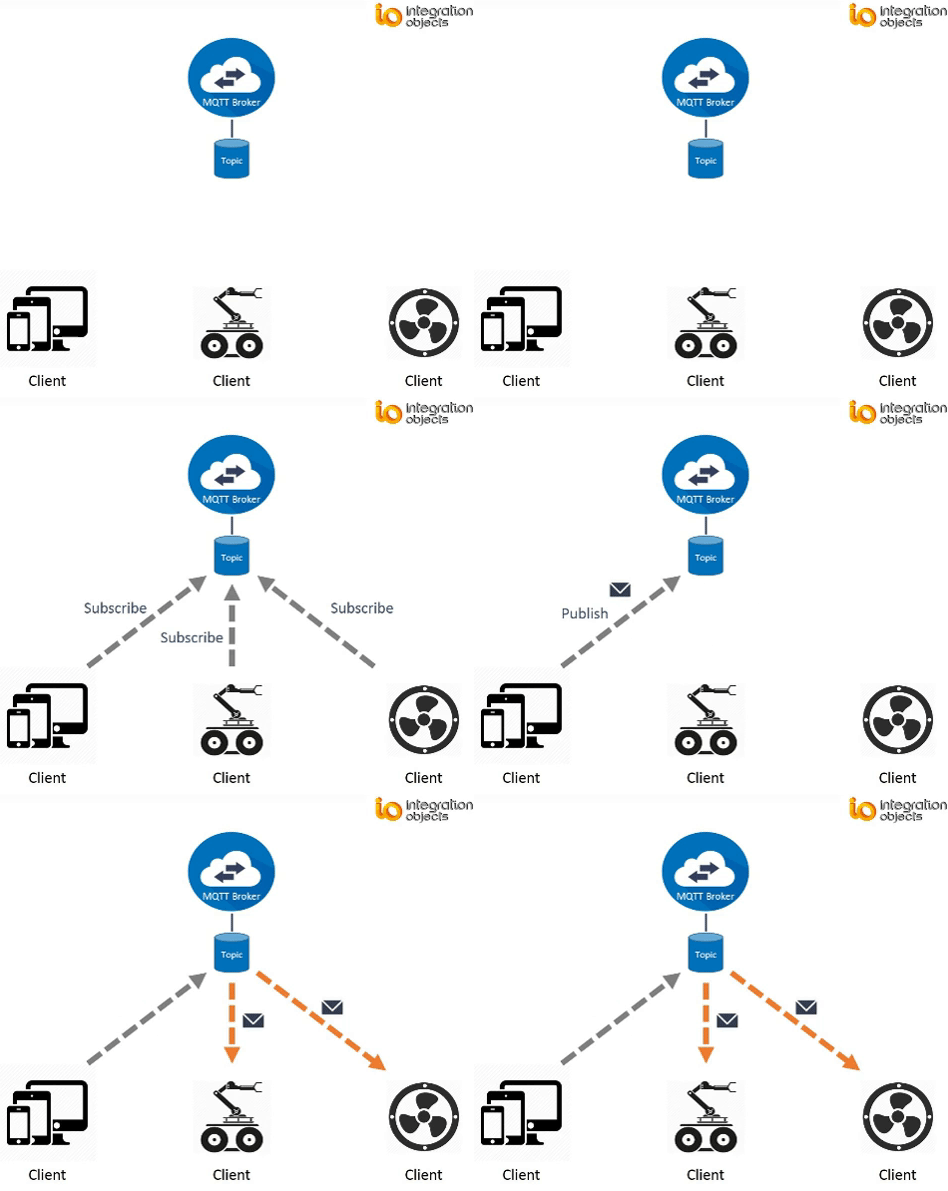
MQTT (Message Queuing Telemetry Transport) is an open, OASIS-standardized messaging protocol built around three components: publishers that send data, a broker that routes it, and subscribers that receive it. Devices exchange messages on named topics rather than talking to each other directly, which decouples data producers from data consumers and lets thousands of devices connect through a single broker without point-to-point wiring.
This guide covers why MQTT fits industrial environments, how it compares to the protocols it’s replacing, and how to architect it at scale. For a deeper walkthrough of MQTT’s topic structure, wildcards, and Quality of Service (QoS) levels, see What Is MQTT: A Deep Dive into MQTT and the Role of MQTT Universal Broker.
Why MQTT Became the Standard Messaging Protocol for Industrial IoT
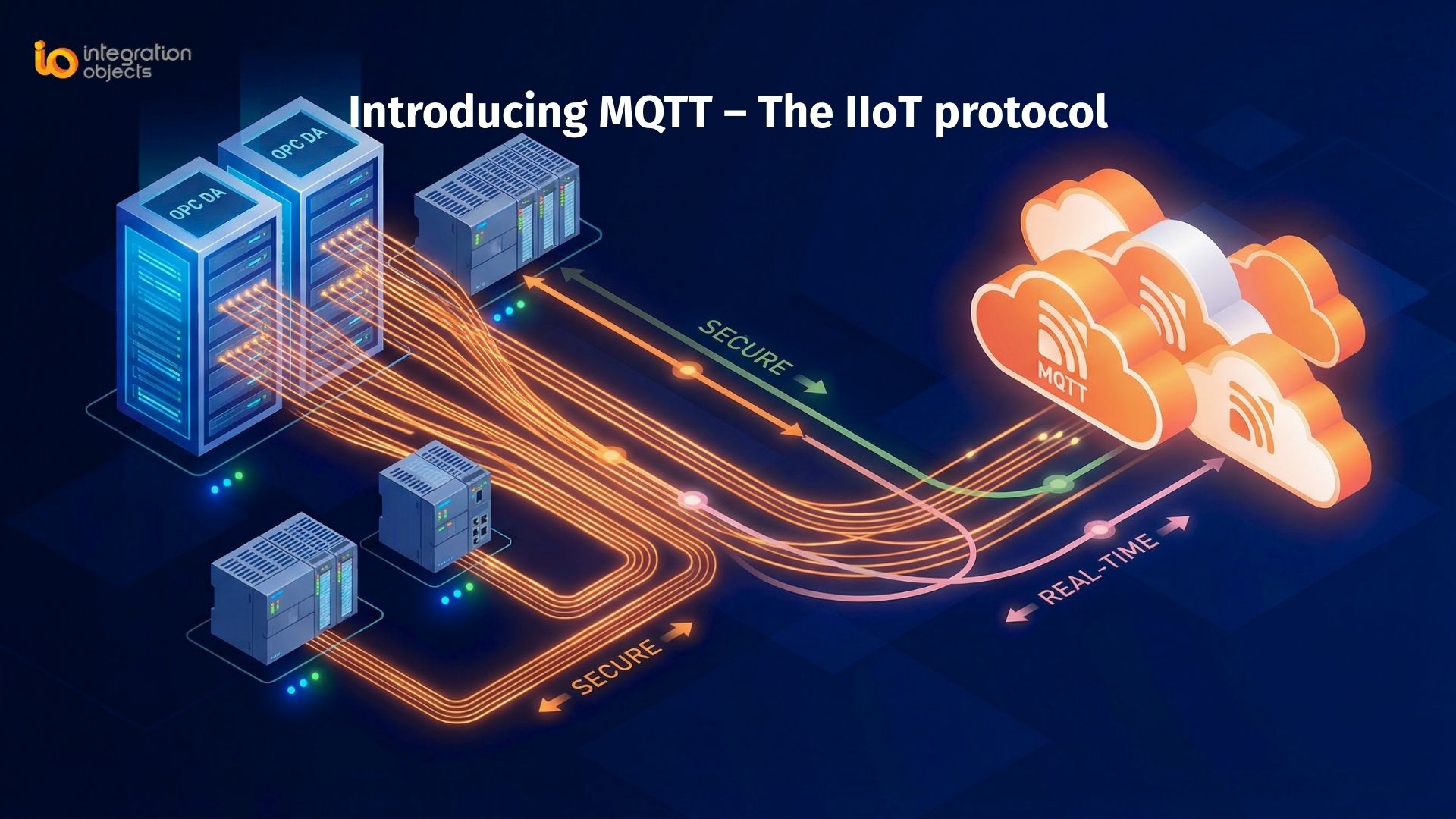
Most legacy industrial protocols – OPC DA, Modbus RTU, many SCADA polling loops – work by repeatedly asking a device “what’s your value now?” on a fixed interval, whether or not anything has changed. That approach is fine on a local plant network with a handful of tags, but it breaks down once you’re monitoring thousands of remote sensors over cellular, satellite, or otherwise constrained links.
MQTT flips that model. Devices report only when a value changes (or on a heartbeat), the broker fans that update out to every subscriber, and the network carries a fraction of the traffic a polling architecture would generate. Combined with a minimal 2-byte protocol header and support for intermittent connections, that’s what makes MQTT practical for oil and gas fields, remote pump stations, and distributed utility assets – exactly the environments IIoT initiatives are trying to connect.
MQTT vs. Traditional Industrial Protocols
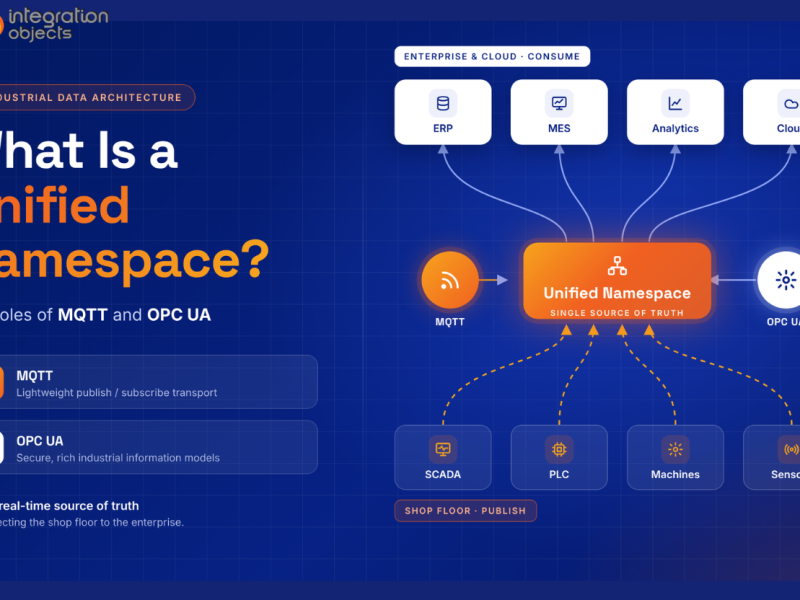
MQTT is not a replacement for OPC UA or Modbus at the plant-floor level – it’s a transport layer that typically sits alongside or downstream of them, moving already-collected data onward to the cloud or an enterprise system. The table below compares where each fits.
|
Characteristic |
MQTT |
Modbus / OPC DA (polling) |
OPC UA |
|
Communication model |
Publish/subscribe, event-driven |
Request/response polling |
Client/server, with pub/sub extensions |
|
Bandwidth use |
Low – sends only on change |
High – constant scanning |
Moderate, configurable |
|
Best fit |
Edge-to-cloud, remote/constrained links, IT/OT bridging |
Local plant-floor device polling |
Plant-floor interoperability with rich data modeling |
|
Native security |
None – layered via TLS/auth |
Minimal |
Built-in (certificates, encryption) |
MQTT Sparkplug B: Solving the Interoperability Gap
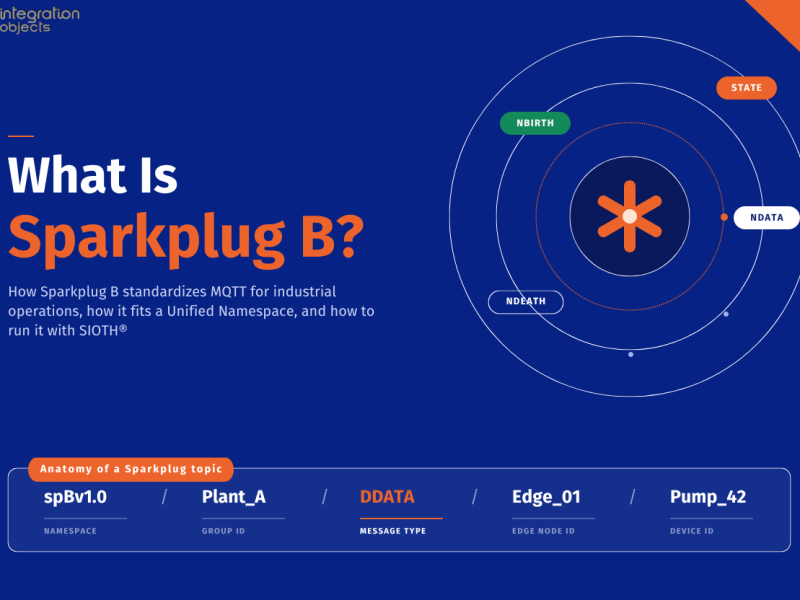
Raw MQTT defines how messages move, not what they mean – two systems can both speak MQTT and still disagree on payload format or how to represent a device going offline. Sparkplug B is a specification built on top of MQTT that standardizes payload structure and adds session/state awareness, so an OT device’s data can be understood consistently by any Sparkplug-compliant consumer without custom mapping.
That interoperability layer is increasingly a requirement, not a nice-to-have, in mixed-vendor plants running OPC UA on the floor and MQTT to the cloud.
See Combining MQTT Sparkplug and OPC UA for how the two standards work together, and MQTT Sparkplug in the Automotive Industry for a vertical-specific example.
How MQTT Fits Into an Industrial Architecture
A typical industrial MQTT deployment has three layers: edge devices and PLCs generating data, a broker (or tiered brokers) handling routing and scale, and downstream consumers – SCADA, historians, cloud analytics – subscribing to what they need. Because most plant-floor data doesn’t originate in MQTT, protocol translation is usually the missing piece: something has to convert OPC UA, Modbus, DNP3, or SNMP sources into MQTT topics before the rest of the architecture can consume them.
SIOTH® – Securely Transport Your Field Data to the Cloud with MQTT walks through that architecture in more detail, including how a broker sits between constrained field networks and cloud or enterprise systems.
Common Industrial Use Cases for MQTT
- Predictive maintenance – streaming vibration, temperature, and pressure data to flag equipment issues before failure
- Remote monitoring and control – extending visibility to assets that are impractical to poll continuously (pipelines, remote pumping stations, offshore equipment)
- Energy management – aggregating consumption data across distributed equipment with low-overhead updates
- Edge-to-cloud IIoT dashboards – feeding real-time operational data into cloud analytics and enterprise systems
- Supply chain and asset tracking – bridging legacy plant systems with modern logistics and inventory platforms
Where MQTT Falls Short in Industrial Deployments
MQTT’s simplicity is also its limit. The protocol has no built-in security – TLS/SSL and authentication have to be layered on deliberately. It isn’t designed for large payloads or file transfer. And at industrial scale, the broker itself becomes a critical piece of infrastructure: without clustering, protocol translation, and IT/OT bridging built in, a single open-source broker can become a bottleneck or a single point of failure across a plant-wide deployment.
Bridging MQTT With the Rest of Your OT Stack
This is the gap Integration Objects’ MQTT Universal Broker is built to close. Rather than treating MQTT as an isolated add-on, it converts multiple industrial protocols – OPC UA, OPC Classic, Modbus, DNP3, SNMP, Profinet, BACnet, IEC 60870-5 – into a single MQTT (or MQTT Sparkplug B) stream, with TLS/SSL security and a rule engine for transforming raw data into usable alerts and aggregates before it ever reaches the cloud.
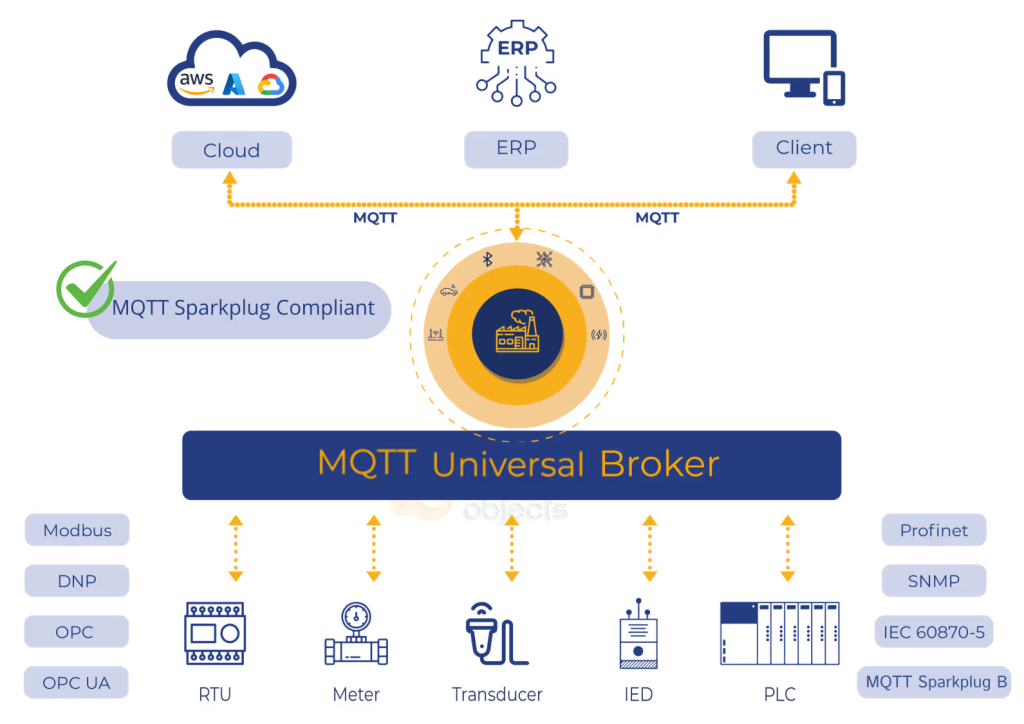
Explore the Industrial MQTT Content Hub
This guide is the starting point for the Industrial MQTT cluster. Continue with:
- What Is MQTT: A Deep Dive into MQTT and the Role of MQTT Universal Broker: protocol architecture, topics, and QoS levels explained
- Combining MQTT Sparkplug and OPC UA: how the two standards work together for plant-to-cloud interoperability
- MQTT Sparkplug in the Automotive Industry: a vertical-specific implementation example
- SIOTH®: Securely Transport Your Field Data to the Cloud with MQTT: architecture and product deep dive
Frequently Asked Questions:
Is MQTT the same as OPC UA?
No. OPC UA is typically used for plant-floor interoperability and rich data modeling between industrial devices, while MQTT is a lightweight transport protocol most often used to move that data onward to the cloud or enterprise systems. Many architectures use both together.
What is MQTT Sparkplug B?
Sparkplug B is a specification built on top of MQTT that standardizes payload format and device/session state, solving the interoperability gaps that arise when different systems implement raw MQTT differently.
Is MQTT secure for industrial use?
MQTT has no built-in security by default - encryption and authentication must be added through TLS/SSL and access controls. Industrial-grade brokers add these protections along with certificate management and role-based access.
What is the role of a broker in an industrial MQTT architecture?
The broker routes messages between publishers and subscribers and, in industrial deployments, often also handles protocol translation - converting OPC UA, Modbus, DNP3, or SNMP sources into MQTT - plus scaling to handle large numbers of concurrent device connections.
How does MQTT compare to traditional SCADA polling protocols?
Traditional SCADA polling repeatedly queries devices on a fixed interval regardless of whether values changed, consuming more bandwidth. MQTT devices publish only when data changes, which reduces network load and scales better across distributed or bandwidth-constrained sites.