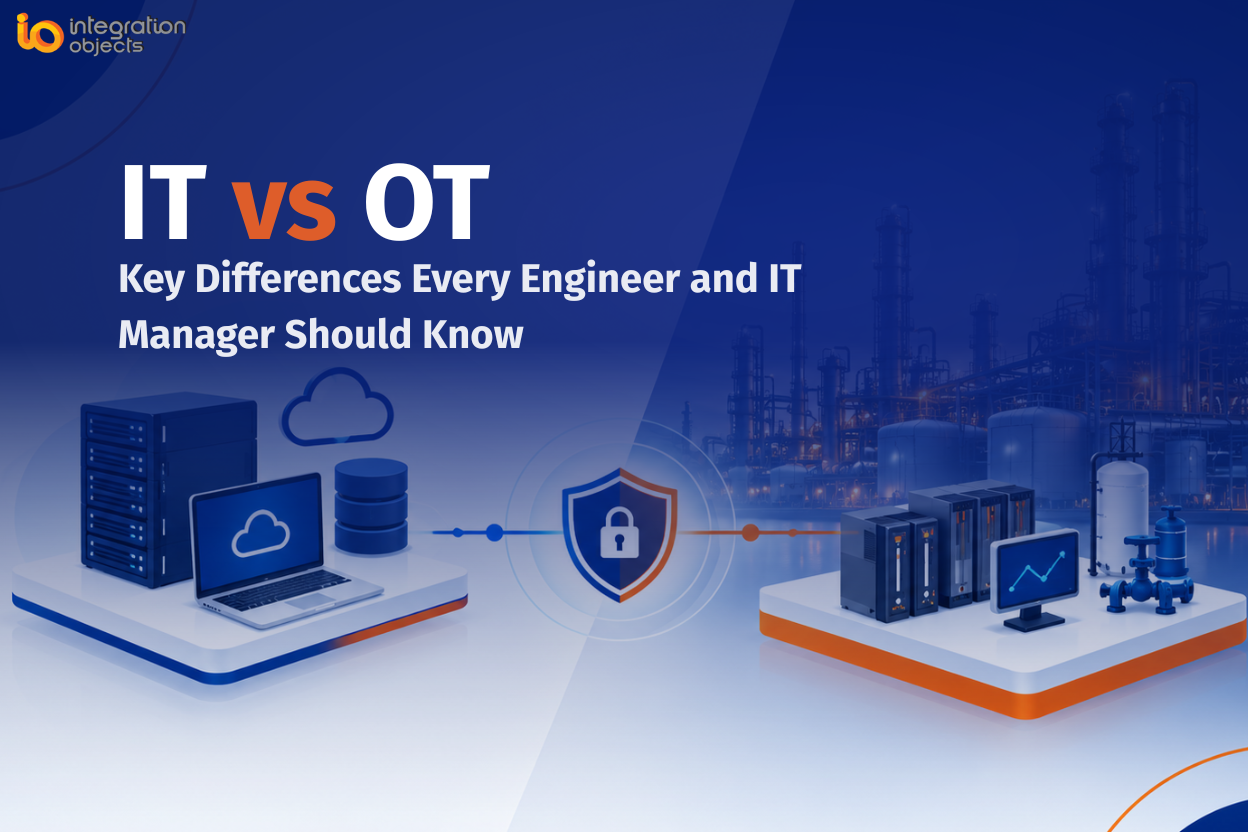
Information technology (IT) manages data, applications and business processes. Operational technology (OT) monitors and controls physical equipment and industrial processes, from pumps and compressors to entire refineries and desalination plants. The core difference is what each one protects first: IT puts the confidentiality of data first, while OT puts safety and the continuous availability of the process first. That single difference explains why the two worlds patch, network, buy and staff so differently.
This guide compares IT and OT across eight dimensions, shows where they meet in the Purdue Model, and explains how to connect them without putting operations at risk. For the bigger picture of why the two domains are merging, read our pillar guide, What Is IT/OT Convergence? Architecture, Security and First Steps.
|
What Is Information Technology (IT)?
IT covers the hardware, software and networks that create, store and exchange information: enterprise resource planning (ERP) systems, email, databases, business intelligence, cloud platforms and the corporate network that connects them. IT systems handle transactions, records and communication. When an IT system fails, the business loses data or productivity, but nothing physical is directly affected.
What Is Operational Technology (OT)?
OT is the hardware and software that monitors and controls physical equipment, processes and events. The systems that make up OT are often called industrial control systems (ICS). Typical OT components include:
- Programmable logic controllers (PLCs) and remote terminal units (RTUs) that execute control logic and collect field data
- Distributed control systems (DCS) that run continuous processes in refineries, power plants and desalination plants
- Supervisory control and data acquisition (SCADA) systems and human-machine interfaces (HMIs) that give operators visibility and control across sites (see What Is SCADA?)
- Process historians that record time-series data for operations and engineering
- Safety instrumented systems (SIS) that bring a process to a safe state when operating limits are exceeded
When an OT system fails, the consequences are physical: a pump trips, a line overpressures, a batch is lost, or people are put at risk.
IT vs OT at a Glance
| Dimension | Information technology (IT) | Operational technology (OT) |
| Primary purpose | Process, store and protect information | Monitor and control physical processes |
| Top priority | Confidentiality of data | Safety and availability of the process |
| Impact of failure | Mostly digital and recoverable: data loss or exposure, financial cost, reputational damage | Physical and potentially irreversible: injury or loss of life, equipment damage, environmental release, lost production |
| Typical lifecycle | A few years per hardware generation | Often decades, aligned with plant assets |
| Patching | Frequent, scheduled, largely automated | Vendor-qualified, tied to maintenance windows, sometimes not possible |
| Timing | Best effort; short delays are tolerable | Deterministic; milliseconds can matter |
| Protocols | TCP/IP, HTTPS, SQL, REST APIs | Modbus, DNP3, IEC 61850, PROFINET, EtherNet/IP, OPC Classic, OPC UA |
| Typical systems | ERP, email, databases, cloud services | PLC, RTU, DCS, SCADA, HMI, historian, SIS |
| Owners | Chief information officer (CIO) and the IT department | Operations, automation and process engineering |
| Key standards | ISO/IEC 27001 | ISA-95, ISA/IEC 62443 |
8 Key Differences Between IT and OT
1. Security priorities: confidentiality first vs safety and availability first
IT security follows the CIA triad: confidentiality, integrity and availability, in that order. A breach that exposes customer or financial data is the worst outcome, so IT accepts taking a system offline to contain a threat. OT reverses the order. An unplanned stop can endanger people and halt production, and a wrong command can damage equipment. Integrity still matters: an operator who cannot trust a level reading cannot run the plant safely.
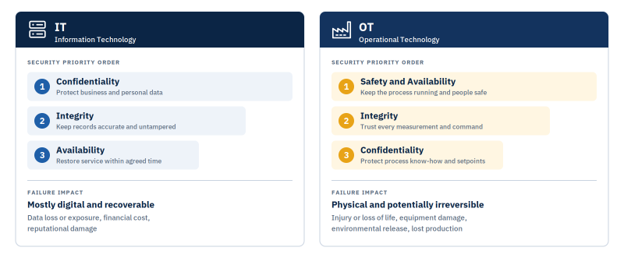
The practical consequence: a control that automatically blocks or quarantines traffic is good practice in IT but can be dangerous in OT if it interrupts control communications.
2. Consequences of failure: recoverable data loss vs physical harm
IT incidents can be serious: ransomware or a data breach can stop business operations, expose sensitive data and lead to regulatory penalties. The damage, however, stays mostly digital and financial, and systems can usually be restored from backups. OT incidents reach the physical world. A failed or manipulated control system can injure people, damage equipment, release hazardous material into the environment and stop production. None of this can be undone by a restore. This is why OT engineers require every change to be tested against the process before it reaches a running plant, and why restarting a controller to see whether a problem clears is not an acceptable fix.
3. Lifecycles: years vs decades
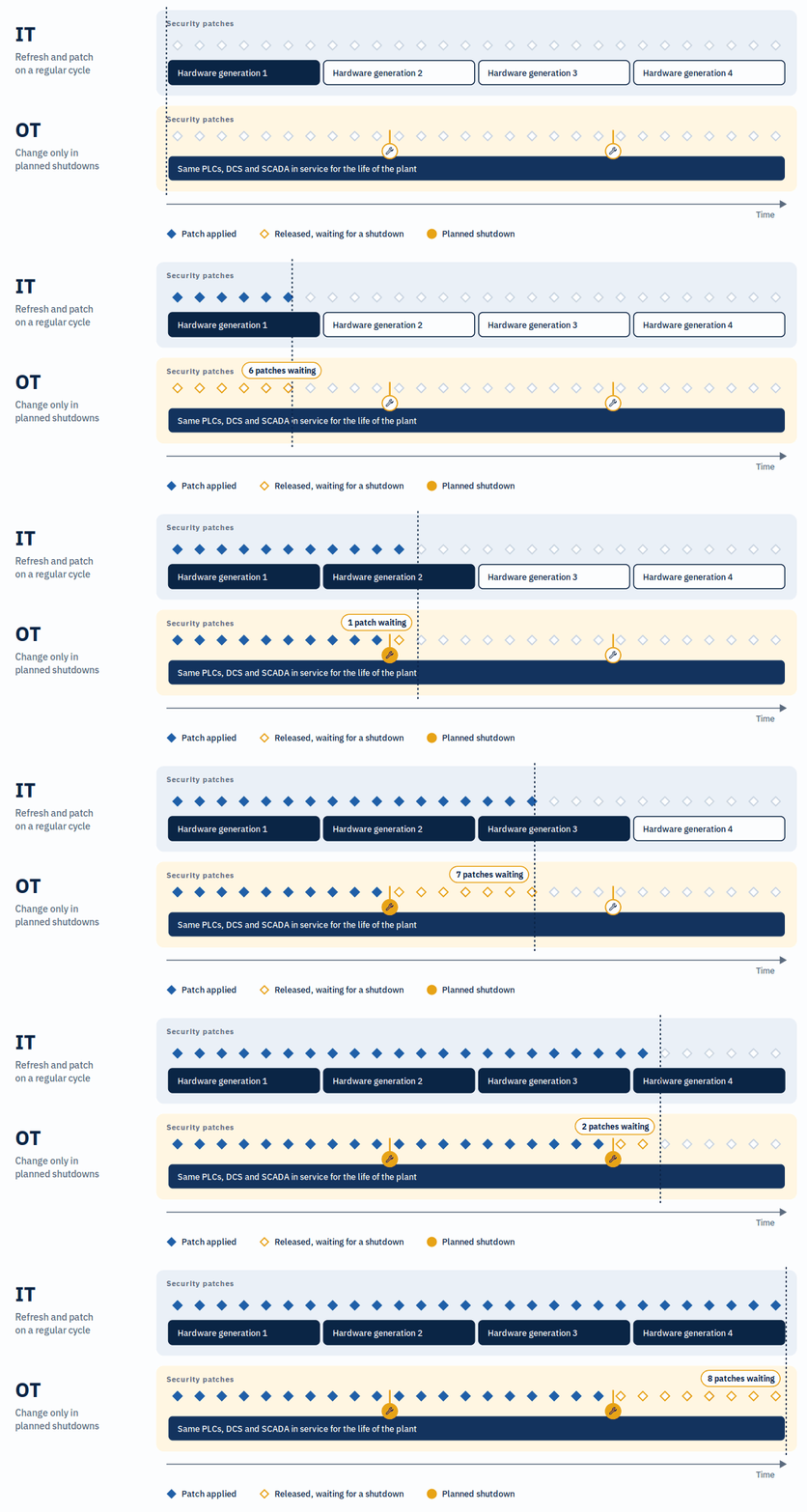
IT hardware is refreshed every few years. PLCs, DCS controllers and SCADA systems often stay in service for decades and are replaced only during major plant shutdowns. As a result, most industrial sites run a mix of modern OPC UA-capable devices and legacy equipment that only speaks Modbus, serial protocols or OPC Classic. Any integration strategy must work with this installed base rather than require replacing it. Where a legacy OPC Classic server has to stay, OPC UA Wrapper exposes it to OPC UA clients, so new applications can use OPC UA without touching the server.
4. Patching and change management
IT applies operating system security updates on a regular monthly cycle. In OT, a patch must be qualified by the control system vendor, scheduled into a maintenance window and sometimes deferred until the next planned shutdown. Some legacy systems cannot be patched at all and must be protected by compensating controls such as network segmentation.
Routine IT changes can still reach OT. DCOM hardening, enforced by Microsoft since March 2023, has required many sites to revisit how their OPC DA (Data Access) connections authenticate, because OPC Classic relies on the Distributed Component Object Model (DCOM). See What Is DCOM? for background. Similarly, Windows Server 2016 extended support ends on January 12, 2027, which affects OT servers still running that platform.
Where OPC Classic data must cross networks, OPCNet Broker DA HDA AE carries OPC DA, HDA and AE data without DCOM through a single open TCP port. The free OPC DA Test Client helps confirm that connections still work after hardening changes.
5. Protocols and data
IT runs on TCP/IP, HTTPS, SQL databases and REST application programming interfaces (APIs). OT uses a wide range of industrial protocols, many designed before cybersecurity was a design requirement: Modbus, DNP3 (Distributed Network Protocol 3), IEC 60870-5-104, IEC 61850, PROFINET, EtherNet/IP and vendor protocols such as Siemens S7. For OPC-based applications, OPC Server for Modbus provides one OPC connection to many Modbus devices.
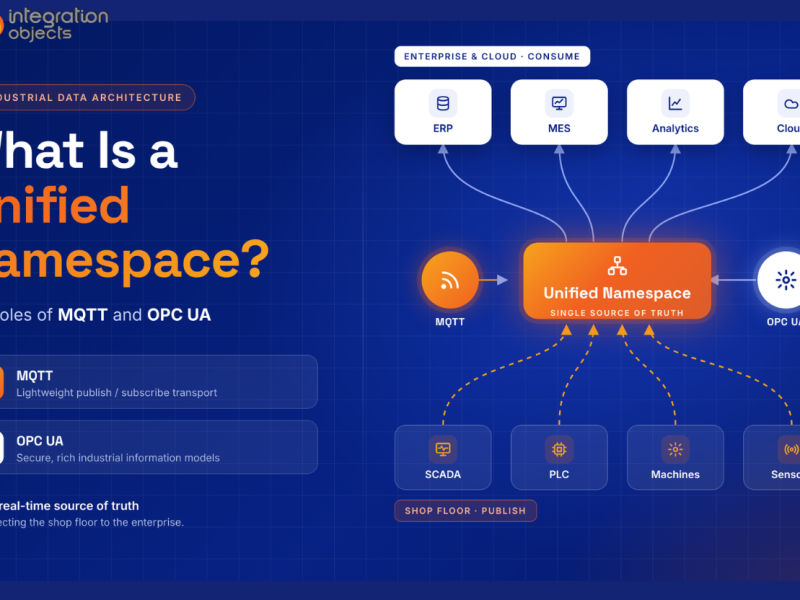
Two standards increasingly bridge the gap. OPC UA (Open Platform Communications Unified Architecture) provides secure, platform-independent access to industrial data with a rich information model. MQTT (Message Queuing Telemetry Transport) is a lightweight publish/subscribe protocol widely used for Industrial Internet of Things (IIoT) data and as the backbone of a Unified Namespace (UNS), usually with the Sparkplug B specification. For a detailed comparison, see MQTT vs OPC UA.
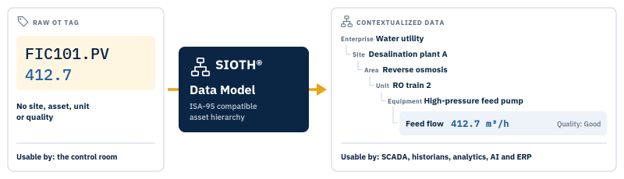
The data itself also differs. OT produces time-series values with timestamps and quality codes, identified by tag names such as FIC101.PV. IT systems expect records with business context: which asset, which site, which unit of measure. Without that context, OT data is hard to use outside the control room.
6. Timing and determinism
Control loops need predictable, deterministic response times. IT networks are designed for throughput and tolerate variable latency. Tools that are routine in IT, such as active network scans or heavy database queries, can overload older controllers and disturb the process. In OT, passive monitoring is the safer default, and any active scanning should be tested before it touches production systems.
7. Network architecture
IT networks are built for connectivity, with users, cloud services and the internet all reachable by design. OT networks are built for isolation: they are segmented into zones and conduits, following the Purdue Model and ISA/IEC 62443. For years many plants relied on air gaps, but remote operations, analytics and cloud reporting have made true isolation rare. Our pillar guide, What Is IT/OT Convergence? Architecture, Security and First Steps, explains why air gaps no longer hold.
8. People, skills and ownership
IT is run by system administrators, network engineers and security analysts reporting to the CIO. OT is run by control engineers, instrument technicians and operators reporting to plant management. The teams use different vocabularies, measure success differently and often report to different executives. Many IT/OT projects stall on ownership and trust rather than on technology, so agreeing roles early matters as much as choosing tools.
Where IT and OT Meet: The Purdue Model and the Industrial DMZ
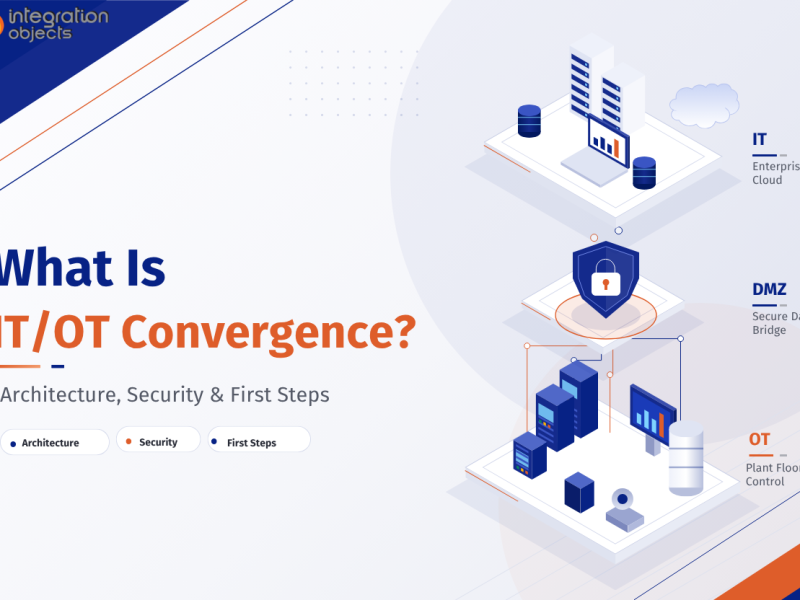
The Purdue Model organizes industrial networks into levels. Levels 0 to 2 contain the physical process, basic control (PLCs, RTUs, DCS controllers) and supervisory control (SCADA and HMI). Level 3 hosts site operations such as plant historians. Levels 4 and 5 are the enterprise IT network. Between them sits Level 3.5, the industrial DMZ.
The rule is simple: no traffic passes directly between the enterprise network and the control network. Data enters the DMZ from one side, terminates there, and leaves through a new, controlled session on the other side. This protocol break means a compromised IT system has no direct path to a controller.
Our guide What Is IT/OT Convergence? Architecture, Security and First Steps shows the full Purdue layout, including which side opens each connection across the DMZ.
Common Mistakes When Connecting IT and OT
- Direct connections. Opening firewall rules so IT applications can query PLCs or SCADA servers directly.
- IT policies applied unchanged. Pushing IT patch cycles, endpoint agents or active scans onto OT assets without vendor qualification.
- Point-to-point sprawl. Building a new interface for every use case, each with its own firewall rule, credentials and maintenance burden.
- Data without context. Delivering raw tags to analytics teams with no asset, unit or quality information.
- One-sided projects. Running the integration as an IT-only or OT-only initiative instead of a shared one.
For more on protecting older equipment, see our guide to connecting legacy OT systems securely.
How SIOTH® Bridges IT and OT Without Compromising Either
SIOTH® (Smart IoT Highway) is Integration Objects’ IT-OT-IIoT integration platform. It is built around the differences described above: OT keeps control of its systems, IT receives clean, contextualized data, and security sits in the architecture rather than being added afterward. Instead of building point-to-point interfaces, users configure Data Flows between any source and destination.
| IT/OT difference | How SIOTH® addresses it |
| Safety and availability come first | Data flow directionality is configured per flow, so OT decides what, if anything, may be written back to the process. |
| Long lifecycles and legacy assets | Connects to the installed base through OPC UA, OPC Classic (DA, AE, HDA), Modbus TCP/RTU, DNP3, Siemens S7 and Allen-Bradley ControlLogix. Existing SCADA and controllers stay in place. |
| Segmented networks | DMZ-aware deployment aligned with Purdue Model segmentation, a protocol break at the integration layer, reverse connection capability and configurable communication ports. |
| Different security models | TLS/SSL encryption, role-based access control (RBAC), Microsoft Active Directory and OAuth 2.0 authentication. IEC 62443-aligned. |
| Remote and unreliable links | Store-and-forward buffering keeps data when the link to IT is down and delivers it when the link is restored. |
| Tags without context | The Data Model module provides ISA-95 compatible, hierarchical asset modeling that turns tags into structured, contextualized data. |
| IT speaks different protocols | Publishes data to MQTT, AMQP, REST, SQL databases, Kafka and Azure Event Hub, with native connectivity to AVEVA PI, AVEVA PI AF and InfluxDB. |
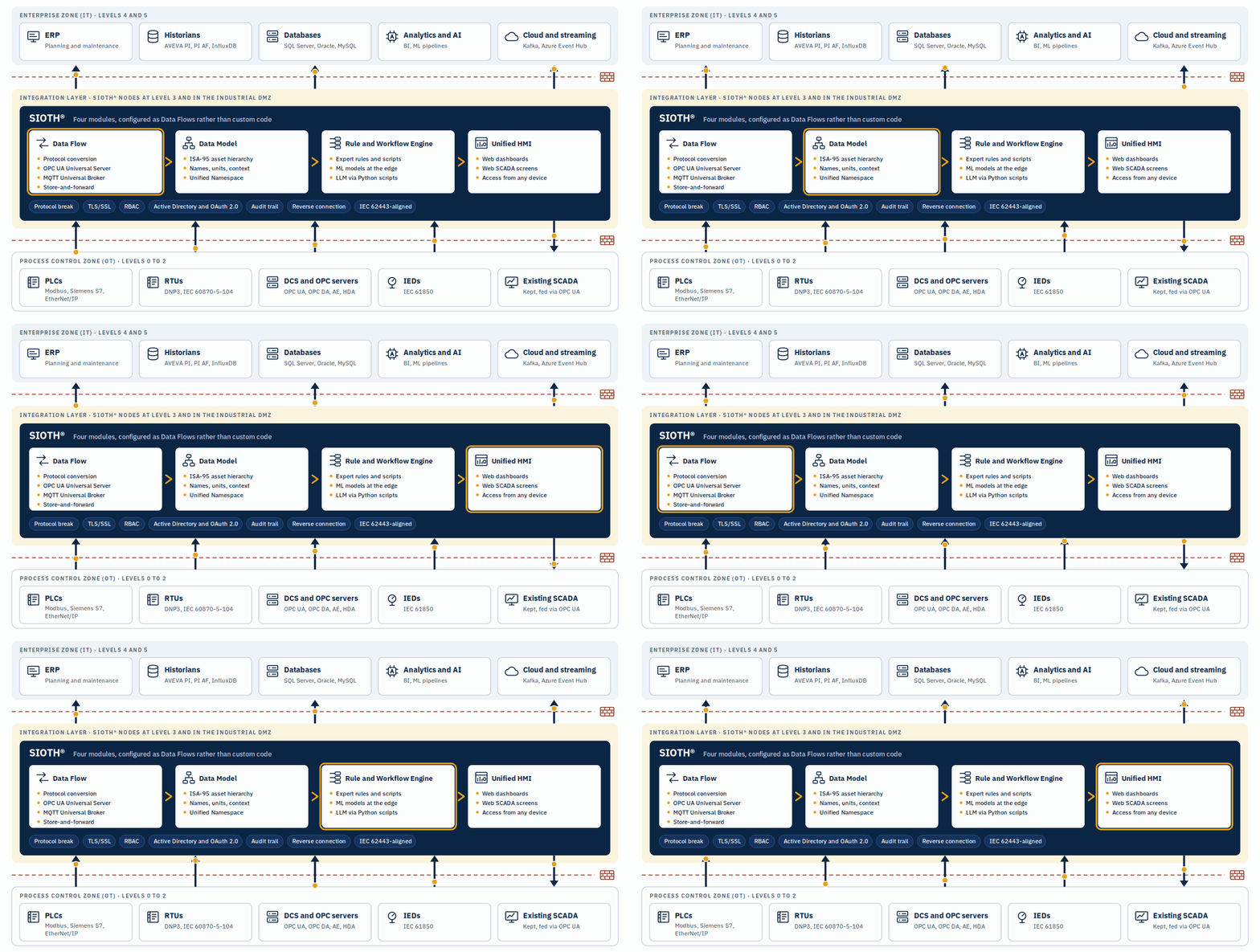
SIOTH® has four modules. Data Flow moves data in both directions between OT, IT and cloud systems and hosts two configurable servers: the OPC UA Universal Server, which exposes all connected OT sources as a single secure OPC UA endpoint, and the MQTT Universal Broker, which is Eclipse Sparkplug B certified and supports a Unified Namespace. Data Model adds asset structure and context. The Rule and Workflow Engine runs expert rules, scripts and machine learning (ML) models, including at the edge. Unified HMI gives both teams web-based dashboards accessible from any device.
Because SIOTH® feeds existing SCADA and historians rather than replacing them, OT teams keep their validated control systems, and IT teams gain a single, governed source of operational data. SIOTH® is deployed in oil and gas, water and desalination, and mining operations.
Before You Connect IT and OT: 7 Questions to Agree On
- Which data does IT actually need, and at what frequency and resolution?
- In which direction may data flow, and who approves any write-back to OT?
- Where does the protocol break sit, and which direct firewall rules can it remove?
- How will legacy assets such as OPC Classic, Modbus and serial devices be connected without changes to the control system?
- What context (asset, unit, quality, timestamp) travels with each value?
- Who owns patching, certificates and user access for the integration layer?
- What happens to the data when the link between OT and IT is down?
Frequently Asked Questions
What is the difference between IT and OT security?
IT security protects the confidentiality of data first. OT security protects safety and availability first. OT security therefore relies on segmentation, protocol breaks, qualified patching and compensating controls, guided by standards such as ISA/IEC 62443.
Can IT security tools be used on OT networks?
Some can, with care. Passive monitoring is generally safe. Active scanning, endpoint agents and automatic blocking must be tested and approved by OT and the control system vendor before use on production systems.
What is the Purdue Model?
The Purdue Model is a reference architecture that organizes industrial networks into levels, from the physical process (Level 0) to enterprise systems (Levels 4 and 5). The original model had no DMZ. Modern reference architectures add an industrial DMZ (Level 3.5) between OT and IT, in line with the zones and conduits approach of ISA/IEC 62443.
What is IT/OT convergence?
IT/OT convergence is the integration of operational data and systems with enterprise IT so that both can share data securely. Read the full guide: What Is IT/OT Convergence? Architecture, Security and First Steps.
Connect IT and OT on Your Terms
Every site has its own mix of legacy equipment, network rules and team responsibilities. Our engineers can review your architecture and show how SIOTH® connects your OT systems to IT without direct connections into the control network.
Related Products
- SIOTH® (Smart IoT Highway): the IT-OT-IIoT integration platform, configured through Data Flows.
- SIOTH® SCADA: web-based SCADA and dashboards for process and operations monitoring.
- OPC UA Universal Server: a configurable server within SIOTH® Data Flow that exposes connected sources as one secure OPC UA endpoint.
- MQTT Universal Broker: a configurable server within SIOTH® Data Flow, Eclipse Sparkplug B certified.
- OPC UA Wrapper: exposes OPC Classic (DA, HDA, AE) servers to OPC UA clients.
- OPCNet Broker DA HDA AE: DCOM-free tunneling of OPC Classic data across networks.
- OPC DA Test Client: a free tool for monitoring, testing and troubleshooting OPC DA servers.