Industrial systems generate large volumes of alarms and events every day. Temperature deviations, equipment warnings, state changes, operator actions, and system notifications constantly flow through control rooms. While these alarms are critical for real-time response, their value extends far beyond the moment they appear on an operator screen.
Yet in many industrial environments, alarms and events are treated as short-lived alerts rather than long-term sources of insight. Limited retention, fragmented archives, and unreliable data capture often result in lost context, making it difficult to investigate incidents, improve safety, or learn from past events.
This blog explores:
- why archiving alarms and events is essential for modern industrial operations,
- the common challenges organizations face when managing alarm history,
- and what it takes to build an effective and reliable alarm archiving strategy.
It also shows how OPC Easy Archiver addresses these challenges by centralizing, filtering, and securely storing OPC alarms and events (OPC A&E), transforming raw alarm data into actionable operational intelligence.
The Hidden Value of Alarms and Events Data
Most industrial teams focus on reacting to alarms in real-time. Once the immediate issue is resolved, the alarm history is rarely revisited. However, alarms and events contain detailed information about how processes behave over time, how systems interact, and how incidents unfold.
When archived correctly, alarms and events become more than notifications. They provide insight into recurring issues, early warning signs, and operational patterns. This historical perspective supports safer operations, faster troubleshooting, and more informed decision-making across engineering, operations, and maintenance teams.
Why Alarms and Events Are Often Lost or Underused
Despite their importance, alarm and event data are frequently under-utilized due to structural limitations:
- Many OPC Alarms and Events servers have limited retention capabilities. Once buffers fill up, older alarms are overwritten.
- In addition, alarms are often generated by multiple OPC AE servers across different systems and sites, leading to fragmented archives and no centralized historical view.
- Most industrial historian systems do not natively support OPC Alarms & Events messages. as they are designed to accept tag-based data.
Without consolidated alarm history, teams struggle to perform meaningful sequence-of-events analysis or root cause investigations. This challenge is further amplified by growing industry and regulatory expectations to retain reliable alarm records for audits, reviews, and operational accountability.
Why Archiving Alarms and Events Matters and What It Takes to Do It Right
When alarms and events are properly archived, organizations can:
- Reconstruct sequences of events leading to incidents or process upsets
- Investigate issues faster using historical alarm context
- Identify recurring or critical alarms that require corrective action
- Maintain reliable records for reporting and operational reviews
Alarm history transforms alarms from reactive signals into long-term operational intelligence.
To deliver this value, an effective alarm archiving solution must meet several key requirements:
- It must collect alarms and events from multiple OPC AE servers, , while accurately capturing alarm occurrence, acknowledgment, and return-to-normal states.
- Timestamps must remain consistent across systems,
- The archive should be independent of HMI or DCS behavior, providing a neutral and vendor-agnostic record.
- Reliability is essential. Alarm data must be captured continuously, even during network or database disruptions.
- Centralized storage in standard databases ensures long-term accessibility, while filtering, visualization, and acknowledgment tracking help keep the data meaningful.
- Scalability is also critical, especially in environments where alarm volumes continue to grow.
How OPC Easy Archiver Supports Alarms and Events Archiving
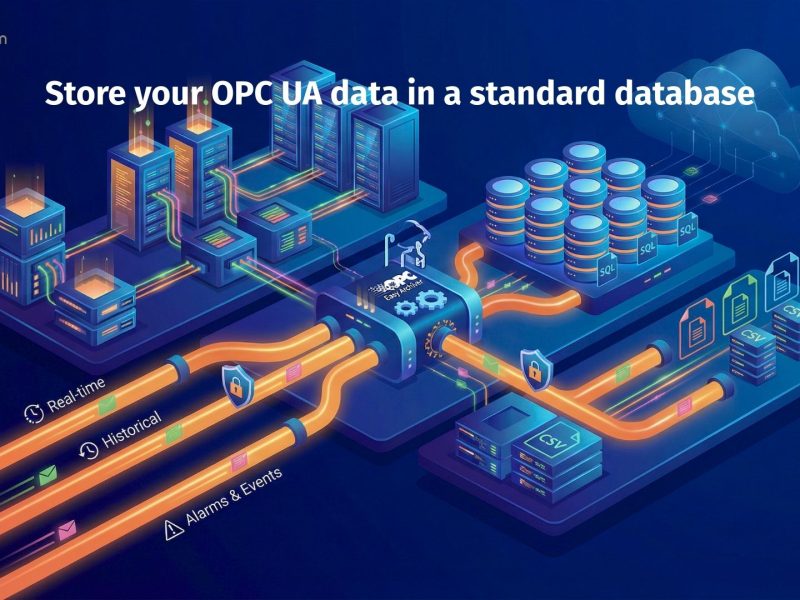
OPC Easy Archiver is designed to meet these requirements and simplify alarms and events historization in industrial environments. It operates as a fully compliant OPC Alarms and Events client, supporting OPC AE specifications and enabling simultaneous connections to one or more local and remote OPC DA, HDA, and AE servers.
OPC Easy Archiver collects and historizes OPC alarms and events along with vendor-specific event attributes, acknowledgments, and timestamps.
Built-in filtering allows users to focus on relevant alarms by severity, category, and source.
Alarms and events can be stored in industry-standard databases such as Microsoft SQL Server, Azure SQL, Oracle, MySQL, PostgreSQL, Microsoft Access, or into CSV files.
To ensure reliability, OPC Easy Archiver includes Store and Forward capabilities, buffering data locally during communication interruptions with database servers and automatically recovering it once connectivity is restored.
Use Case Example: Centralizing Alarms and Events Across Industrial Systems
An industrial organization operating multiple production systems relied on OPC Alarms and Events for real-time monitoring but lacked long-term alarm database. Alarms were generated by multiple OPC AE servers, making historical analysis and incident investigation slow and fragmented.
By deploying OPC Easy Archiver, the organization centralized alarms and events from multiple OPC servers into a single SQL database. Automatic reconnection and buffering capabilities of the archiver ensured reliable alarm historization even during communication disruptions.
With centralized and structured alarm data, operations teams gained better visibility into alarm patterns, faster access to historical context during incidents, and a stronger foundation for alarms reporting, trend analysis, and sequence-of-events analysis.
Avoiding the “Store Everything Forever” Trap
A key success factor in this deployment was alarm filtering. Instead of archiving every alarm state indefinitely, the organization defined clear filtering rules to avoid unnecessary noise.
Without filtering, alarm archives often become large, slow, and difficult to use. Excessive data volumes lead to slow queries, and ineffective root cause analysis. Using OPC Easy Archiver’s filtering capabilities, the organization focused on relevant alarms while preserving critical context, ensuring the archive remained a practical learning and decision-support tool.
Turn Alarm History into Operational Intelligence
Alarms and events are among the most valuable data sources in industrial systems, but only when they are archived and managed correctly. Structured alarm historization enables safer operations, faster incident response, and better long-term performance analysis.
OPC Easy Archiver provides a reliable and vendor-independent solution for archiving OPC alarms and events and transforming them into actionable insights.
FAQ: Archiving OPC Alarms and Events
Why is Archiving OPC Alarms and Events important in industrial systems?
Archiving OPC Alarms and Events is essential because real-time alarms are only useful at the moment they occur. Without archiving, historical context is lost, making it difficult to investigate incidents, identify recurring issues, or improve operational performance. Alarm history enables better decision-making, compliance, and system reliability.
What types of data are stored when archiving OPC Alarms and Events?
Typical archived data includes alarm messages with their timestamps, acknowledgments, severity levels, source identifiers, and vendor-specific attributes. This structured data helps reconstruct the full sequence of events during industrial incidents.
What are the main challenges in Archiving OPC Alarms and Events?
Common challenges include limited retention in OPC AE servers, fragmented alarm sources across multiple systems, inconsistent timestamp synchronization, lack of native alarm support in traditional historians, and high data volumes requiring filtering and optimization.
How does OPC Easy Archiver help with Archiving OPC Alarms and Events?
OPC Easy Archiver simplifies Archiving OPC Alarms and Events by collecting alarm and event data from multiple OPC AE servers and storing it in SQL databases or files. It ensures reliability through Store and Forward capabilities, supports filtering by severity or source, and maintains data integrity even during network disruptions.
Where does OPC Easy Archiver store alarm and event data typically?
OPC alarm and event data is commonly stored in relational databases such as Microsoft SQL Server, Azure SQL, Oracle, MySQL, or PostgreSQL. It can also be stored into CSV files depending on system requirements and integration needs.
Can archived OPC Alarms and Events be used for analysis and reporting?
Yes. Once archived, OPC alarm and event data can be used for sequence-of-events analysis, root cause investigations, performance monitoring, compliance reporting, and integration with analytics or BI tools.