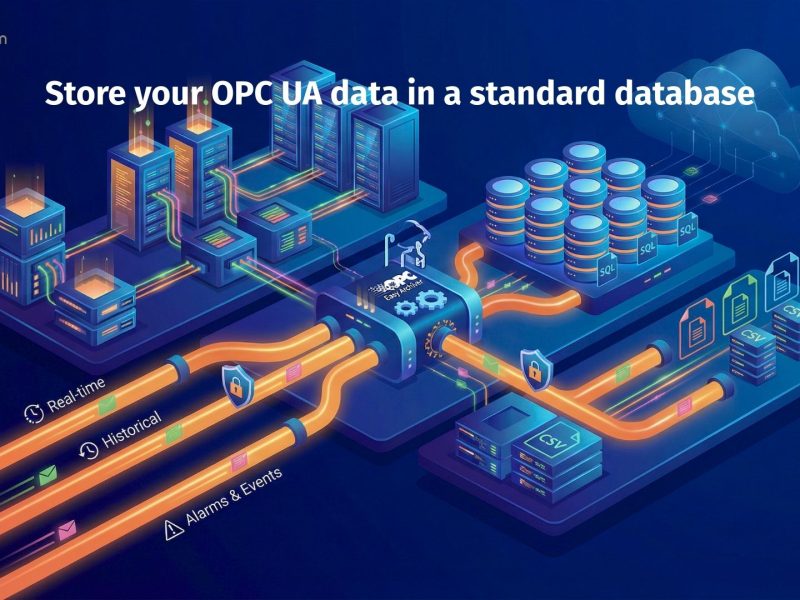
OPC HDA (Historical Data Access) is the standard for accessing historical process data in industrial environments. Historical data is essential for trend analysis, performance monitoring, compliance, and operational intelligence.
This article explains what OPC HDA is, how it works, its industrial use cases, and how tools like OPC Easy Archiver help you reliably store OPC HDA data in databases such as MS SQL Server.
What is OPC HDA?
Historical Data Access (HDA) is an industrial standard that enables clients to access archived process information stored on OPC servers. Unlike real-time data streams, which provide current measurements, HDA focuses on past values and time-stamped records, making it ideal for analyzing trends and evaluating long-term system performance.
With this approach, engineers can retrieve a variety of data types, including:
-
Recorded measurements: Access raw values over time to track machine or process behavior.
-
Time-stamped entries: Ensure every data point is accurately logged, supporting audits, troubleshooting, and synchronization with other systems.
-
Aggregated and trend data: Summarize information with averages, minimums, maximums, or other statistical metrics to observe long-term patterns.
This type of historical data is widely used in industrial automation for applications such as:
-
Performance analysis: Identify inefficiencies by examining how processes have behaved over days, weeks, or months.
-
Compliance reporting: Maintain structured logs to meet regulatory standards and quality requirements.
-
Predictive maintenance: Use trend analysis to anticipate equipment failures and reduce downtime.
-
Root cause investigations: Examine past process data to determine the factors contributing to incidents.
By centralizing historical process information in a structured database, industrial teams gain actionable insights, improve operational efficiency, and create a foundation for advanced analytics and predictive operations.
How OPC HDA Works
OPC HDA operates using a client-server architecture:
-
HDA Client: Requests historical data from the server
-
HDA Server: Stores and provides historical data
-
Communication: Usually via COM/DCOM
Data can include raw values, interpolated values, and aggregated trends, which can then be stored in SQL databases for analysis.
Industrial Use Cases of OPC HDA
OPC HDA is commonly applied in:
-
Performance Monitoring: Track historical trends of equipment or process data
-
Root Cause Analysis: Investigate incidents using historical records
-
Predictive Maintenance: Analyze historical patterns to anticipate failures
-
Compliance Reporting: Maintain structured historical logs for audits
-
Centralized Data Storage: Aggregate data from multiple OPC servers into a single database
Why Archiving OPC HDA Data Matters
Storing OPC data in a structured database such as MS SQL Server provides:
-
Reliable Storage: Protects data from network interruptions using store-and-forward mechanisms
-
Advanced Analytics: Enables SQL queries, BI tools, and dashboards
-
Enterprise Integration: Seamlessly connects with analytics platforms and cloud systems
-
Traceability and Compliance: Maintains structured historical records for regulatory and operational requirements
How OPC Easy Archiver Helps
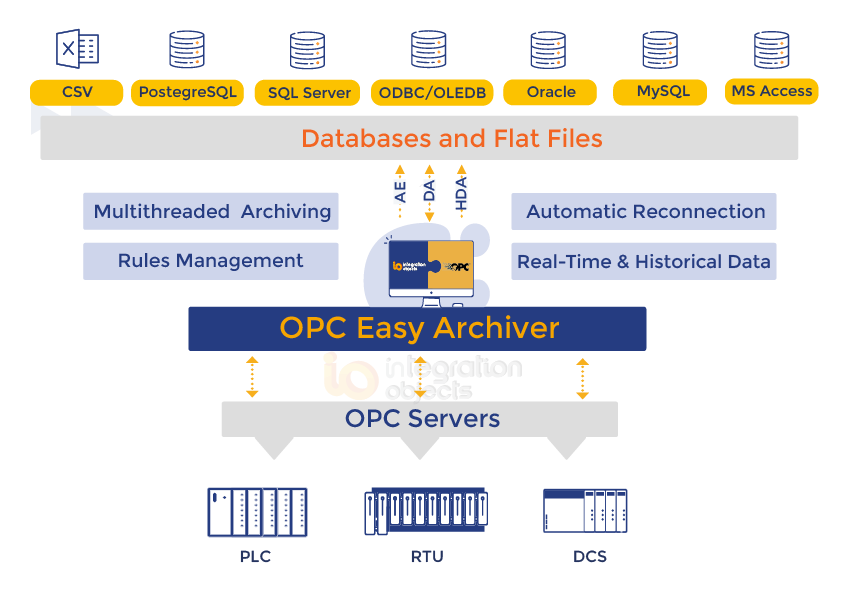
OPC Easy Archiver is a data logging solution designed for industrial environments. It allows you to:
-
Collect OPC HDA, OPC DA, and OPC AE data
-
Store historical data in MS SQL, Azure SQL, Oracle, IBM DB2, MySQL, PostgreSQL, Microsoft Access, or CSV files
-
Ensure reliable data delivery with store-and-forward capabilities
-
Connect to databases via OLEDB or ODBC drivers
For step-by-step tutorials, see our OPC HDA to MS SQL guide.
Conclusion
OPC HDA provides standardized access to historical process data and is critical for industrial operations. By leveraging products like OPC Easy Archiver, you can collect, store, and analyze OPC data efficiently in SQL databases.
FAQ on OPC HDA
What types of data can be retrieved using OPC HDA?
OPC Easy Archiver can collect and archive different types of historical OPC HDA data, including raw time-stamped values, interpolated data, and aggregated statistics such as averages, minimums, and maximums. This supports detailed long-term analysis of industrial processes.
Why is archiving OPC HDA data important?
OPC Easy Archiver ensures reliable archiving of OPC HDA data into structured databases such as MS SQL Server and others. This is important for maintaining data integrity, enabling advanced analytics, supporting compliance requirements, and ensuring traceability of industrial operations.
How is OPC HDA data used in predictive maintenance?
OPC Easy Archiver enables storage of historical OPC HDA data that can be analyzed to detect patterns and anomalies over time. These trends help predict equipment failures early, reduce downtime, and improve maintenance planning in industrial environments.
Can OPC HDA data be stored in SQL databases?
OPC Easy Archiver supports storing OPC HDA data directly into SQL and other databases such as MS SQL Server, MySQL, PostgreSQL, Oracle, and more. This allows easy integration with BI tools, dashboards, and enterprise analytics systems.
What is the architecture behind OPC HDA communication?
OPC Easy Archiver works within an OPC HDA client-server architecture where the client requests historical data and the server provides stored values. Communication is typically based on COM/DCOM, enabling access to raw, interpolated, and aggregated historical data.